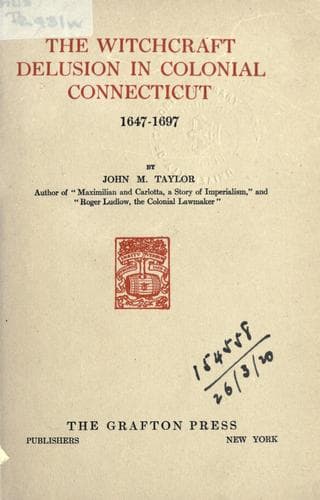
The Witchcraft Delusion in Colonial Connecticut (1647-1697) — John Shaqi
The Witchcraft Delusion in Colonial Connecticut (1647-1697)Taylor, John M. (John Metcalf)
History
The Witchcraft Delusion in Colonial Connecticut (1647-1697)
Taylor, John M. (John Metcalf)
Connecticut -- History -- Colonial period, ca. 1600-1775; Witchcraft -- Connecticut -- History
Above all, in its literature does witchcraft exhibit the conclusive
proof of its age, its hydra-headed forms, and its influence in the
intellectual and spiritual development of the races of men.
What of this literature? Count in it all the works that treat of the
subject in its many phases, and its correlatives, and it is limitless, a
literature of all times and all lands.
Christian and pagan gave it place in their religions, dogmas, and
articles of faith and discipline, and in their codes of law; and for
four hundred years, from the appeal of Pope John XXII, in 1320, to
extirpate the Devil-worshipers, to the repeal of the statute of James I
in 1715, the delusion gave point and force to treatises, sermons,
romances, and folk-lore, and invited, nay, compelled, recognition at the
hands of the scientist and legist, the historian, the poet and the
dramatist, the theologian and philosopher.
But the monographic literature of witchcraft, as it is here considered,
is limited, in the opinion of a scholar versed in its lore, to fifteen
hundred titles. There is a mass of unpublished materials in libraries
and archives at home and abroad, and of information as to witchcraft and
the witch trials, accessible in court records, depositions, and current
accounts in public and private collections, all awaiting the coming of
some master hand to transform them into an exhaustive history of the
most grievous of human superstitions.
To this day, there has been no thorough investigation or complete
analysis of the history of the witch persecutions. The true story has
been distorted by partisanship and ignorance, and left to exploitation
by the romancer, the empiric, and the sciolist.
"Of the origin and nature of the delusion we know perhaps enough; but of
the causes and paths of its spread, of the extent of its ravages, of its
exact bearing upon the intellectual and religious freedom of its times,
of the soul-stirring details of the costly struggle by which it was
overborne we are lamentably ill informed." (_The Literature of
Witchcraft_, p. 66, BURR.)
It must serve in this brief narrative to merely note, within the
centuries which marked the climax of the mania, some of the most
authoritative and influential works in giving strength to its evil
purpose and the modes of accusation, trial, and punishment.
Modern scholarship holds that witchcraft, with the Devil as the arch
enemy of mankind for its cornerstone, was first exploited by the
Dominicans of the Inquisition. They blazed the tortuous way for the
scholastic theology which in the thirteenth and fourteenth centuries
gave new recognition to Satan and his satellites as the sworn enemies of
God and his church, and the Holy Inquisition with its massive enginery,
open and secret, turned its attention to the exposure and extirpation of
the heretics and sinners who were enlisted in the Devil's service.
Public-domain text, read in full here on John Shaqi.
Reviews
Reviews
No reviews yet
Be the first to share your thoughts on this work.
Join the Discussion
Join the discussion
Sign in to leave a comment or review.
Sign InorCreate an account