The Wizard of Wall Street and His Wealth; or, The Life and Deeds of Jay Gould — John Shaqi
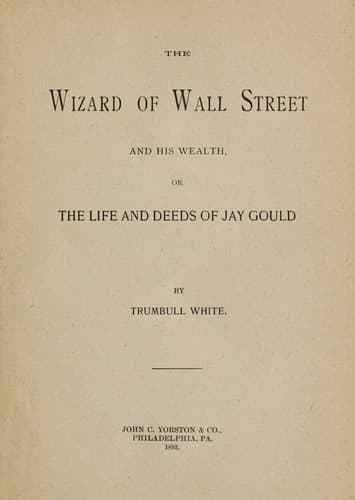
The Wizard of Wall Street and His Wealth; or, The Life and Deeds of Jay GouldWhite, Trumbull
History
The Wizard of Wall Street and His Wealth; or, The Life and Deeds of Jay Gould
White, Trumbull
Businessmen -- United States -- Biography; Capitalists and financiers -- United States -- Biography; Gould, Jay, 1836-1892
It was while working in the tin store, shortly after this, that Gould
took part in a transaction in which one cannot fail to recognize one of
the distinctive traits of his future business career. If the king of
Wall street never went hunting for snipes with a brass band, neither
did the country lad. The merchant for whom he was working also did a
real-estate business. His employer was negotiating for the purchase
of some property belonging to an estate in chancery, and Jay carried
on the correspondence for him. By virtue of his position he thus
learned the particulars of a bargain which his employer desired to
make on the piece of land. The executor demanded twenty-five hundred
dollars, but the would-be purchaser offered only two thousand dollars.
Jay undertook a little investigation on private account, and became
convinced that the property was bound to appreciate in value. While
the negotiations were in progress, Jay borrowed twenty-five hundred
dollars of his father, and outbidding his employer, quietly scooped
in the property. He had the deed made out in his father’s name, and
within two weeks sold out for four thousand dollars. It is said that
his employer looked at the transaction in the light of a breach of
confidence. The result was that it caused a separation between the
merchant and his clerk, and broke up a little romance which is said to
have existed between the young speculator and a young female member of
his employer’s family.
This was practically the end of his life and associations with the
little villages, Roxbury and Hobart, though his map work and surveying,
in the following years, were largely done in the surrounding counties.
As a matter of fact, he had exhausted the possibilities for him in
those country villages. He had squeezed what knowledge and profits were
to be obtained there, and was ready to seek new worlds to conquer.
While the little towns furnished him no inducements for permanent
residence, and but little of the start toward his colossal fortune,
nevertheless, the influences that the towns and their people exerted
on his early life must be credited with much of the better business
qualities, of perseverance and method that gave much of his success in
later years.
Public-domain text, read in full here on John Shaqi.
Reviews
Reviews
No reviews yet
Be the first to share your thoughts on this work.
Join the Discussion
Join the discussion
Sign in to leave a comment or review.
Sign InorCreate an account