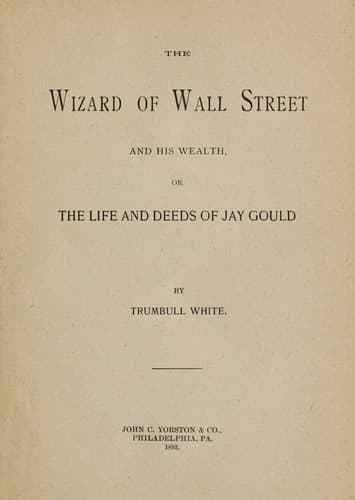
The Wizard of Wall Street and His Wealth; or, The Life and Deeds of Jay Gould — John Shaqi
The Wizard of Wall Street and His Wealth; or, The Life and Deeds of Jay GouldWhite, Trumbull
History
The Wizard of Wall Street and His Wealth; or, The Life and Deeds of Jay Gould
White, Trumbull
Businessmen -- United States -- Biography; Capitalists and financiers -- United States -- Biography; Gould, Jay, 1836-1892
Gould’s mother died in 1841, when he was but five years old. His father
died in 1866, and some years ago their distinguished son erected
over their graves a handsome monument in the village cemetery. The
elder Gould had a farm of about one hundred and fifty acres, and was
esteemed by his neighbors as a worthy citizen. The house in which Jay
was born and spent his boyhood is described as a “two-story, box-like
frame building covered with a coating of white paint.” In July, 1880,
Jay Gould visited his birth-place and also Hobart, where he went to
school. He used to walk the entire distance to school every Monday
morning, returning Saturdays. He was enthusiastically received by the
inhabitants at the time of his visit, as the most noted man ever born
in that region. When he visited the old house, it is to be wondered
if he recalled the first instance in which he ever showed a combative
spirit of bravery. It was during the Anti-rent War, when a party of
anti-renters visited his father’s house to compel him to cease paying
rent, John B. Gould and a neighbor, Hiram Moore, belonging to the
conservative farmers, known as “high-renters.” The “rebels” were masked
and in bad temper, but John B. Gould stood out stoutly for his rights,
while ten-year-old Jay, who stood in the doorway at his side, urged his
father to shoot his assailants down. John B., like the son in manhood,
was small of stature, and had the additional misfortune of having one
leg shorter than the other, but he probably inherited some of the
rugged qualities of grim Captain Abram, and these were likely to be
accentuated by the struggle for existence in the rough sterile country
of their habitation. The vigilance committee, at any rate, left the
little man unharmed, though they promptly proceeded to tar and feather
his neighbor, Hiram Moore.
These anti-rent troubles were caused by the refusal of the occupants
of certain large tracts of land in Delaware and adjacent counties, to
pay an annual rental to persons who claimed to have purchased the land
from the Indians. Such rentals had been paid with a fair degree of
regularity up to 1844, when the farmers rebelled, declaring that the
exactions were oppressive and unlawful. In some cases the rent exacted
had consisted of so many bushels of wheat, a certain number of fowls or
a few days’ labor per year. In other cases cash payments were demanded.
Public-domain text, read in full here on John Shaqi.
Reviews
Reviews
No reviews yet
Be the first to share your thoughts on this work.
Join the Discussion
Join the discussion
Sign in to leave a comment or review.
Sign InorCreate an account