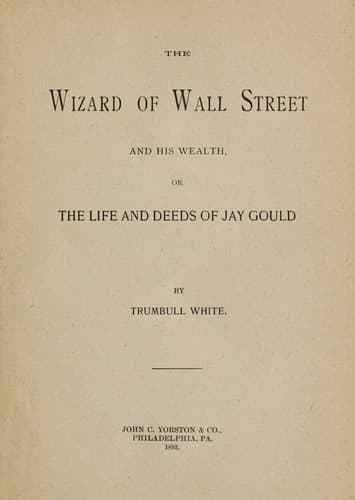
The Wizard of Wall Street and His Wealth; or, The Life and Deeds of Jay GouldWhite, Trumbull
History
The Wizard of Wall Street and His Wealth; or, The Life and Deeds of Jay Gould
White, Trumbull
Businessmen -- United States -- Biography; Capitalists and financiers -- United States -- Biography; Gould, Jay, 1836-1892
The panic of 1857 had left this
road in a demoralized condition, and Gould found that he could buy a
majority of the first mortgage bonds at ten cents on the dollar. He
had now found the true field for his peculiar talent. He made himself
president, treasurer and general superintendent of the road, studied
the business of railroading on the ground, developed the local traffic,
and finally effected the Rensselaer and Saratoga Consolidation. By this
time, both bonds and stocks were good and he sold the latter for one
hundred and twenty dollars.
There has been no time when it was possible to estimate the wealth
of Mr. Gould, and as he was secretive in those early days as in his
later, there was no saying what he was worth when in 1860 he came into
Wall street. One statement has it that when the firm of Smith, Gould
& Martin was organized, Mr. Gould’s possessions amounted to thirty
thousand dollars in cash. Another is that when he sold out his holdings
in the Rensselaer and Saratoga Consolidation, he was worth seven
hundred and fifty thousand dollars.
With a mind peculiarly alert to all the influences which affected the
values of railway securities, with habits of great industry, with
phenomenal tenacity of purpose, with a fair amount at least of capital
to back him, it is not surprising that Mr. Gould profited largely
by his speculation in railway stocks and gold during the war of the
rebellion. The keen-sighted, intelligent men in “the Street” at that
time nearly all made money, and Mr. Gould was at least a millionaire
when the Confederacy fell. What his methods were at the time it is
useless to speculate about. It was before the day when by absolute
mastery of gigantic railway and telegraph systems he could at his will
depress the value of almost any institution on which he fixed his eye
by setting on foot a ruinous war in rates until he had made it to be
his own interest to restore a more normal and healthful condition of
affairs by ceasing his antagonism and building up the property which he
had acquired cheaply during the period of depression. But the details
of his operations were always so subtle as to be shut out from the
discovery of either friend or foe.
Public-domain text, read in full here on John Shaqi.
Reviews
Reviews
No reviews yet
Be the first to share your thoughts on this work.
Join the Discussion
Join the discussion
Sign in to leave a comment or review.
Sign InorCreate an account