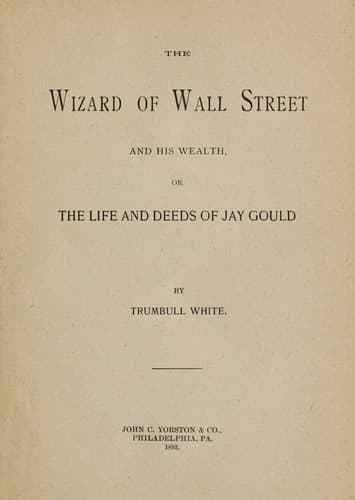
The Wizard of Wall Street and His Wealth; or, The Life and Deeds of Jay GouldWhite, Trumbull
History
The Wizard of Wall Street and His Wealth; or, The Life and Deeds of Jay Gould
White, Trumbull
Businessmen -- United States -- Biography; Capitalists and financiers -- United States -- Biography; Gould, Jay, 1836-1892
Gould was now fairly on the way toward his colossal fortune. Though
friends warned him against entering into the whirlpool of blasted
hopes and ruined fortunes of Wall street, his inclinations in that
direction were too strong to be resisted. Gould was a born speculator.
It is true that his great fortune was created mainly in hazardous
enterprises outside of Wall street, and that in stock speculations,
pure and simple, he was not always so successful or so infallible
as many have supposed, but by nature and habit Gould was at this
time of his life a commercial gambler, and it was as natural that he
should enter Wall street as for a duck to take to water. It was in
1859 or 1860 that Gould first entered Wall street. It was not very
long before he stepped to the front rank. What a long list of brainy
and courageous men do Gould’s contemporaries in the street make! With
most of them Gould has been at sword’s point, with a few he has been
an ally, with some he has been both ally and enemy. Most of them are
no longer powers in the speculative world. Some of them are dead. Not
a few have been overwhelmed in the swift, resistless torrent of stock
speculation. Three or four yet remain with power in their hands and
millions in their vaults. The Vanderbilts--the commodore, his son
and grandsons--Daniel Drew, James Fisk, Jr., the Beldens, Commodore
Garrison, Henry N. Smith, James R. Keene, William Heath, George I.
Seney, Gen. Thomas, Calvin S. Brice, D. O. Mills, Horace F. Clark,
Alfred Sully, Addison Cammack, C. F. Woerishoffer, the Rockefellers, S.
M. Kneeland, C. J. Osborn, D. P. Morgan, H. S. Ives, C. P. Huntington,
Russell Sage, Cyrus W. Field, John W. Garrett, Robert Garrett, J. P.
Morgan, the Seligmans, Brown Bros., Jay Cooke, Hugh J. Jewett, Lathrop,
Little and Austin Corbin, Henry Clews, Washington E. Connor, Burnham,
Gen. E. F. Winslow, Edward S. Stokes, S. V. White, William Dowd, Solon
Humphreys, William R. Travers, Rufus Hatch, Samuel Sloan--these were
some of the men identified with various Wall street interests with
whom Gould has been allied or at enmity, or both, during his long
career in the street. That he has been able among all these financial
giants to make himself the leader is the highest evidence that can
be given of his genius in speculation and railroad financiering. As
we read some of these names there arise before our eyes the visions
of murder, of suicide, of bankruptcy, of the debtor’s prison, of the
felon’s cell, of ruined fortunes and blasted reputations. Others of
the men have achieved wealth and honorable names. It is interesting
to note that at the time Gould first entered the street one of his
fellow-boarders at the Everett House was James Gordon Bennett, the
elder, with whose son and successor he became engaged in such bitter
business and personal antagonisms.
Public-domain text, read in full here on John Shaqi.
Reviews
Reviews
No reviews yet
Be the first to share your thoughts on this work.
Join the Discussion
Join the discussion
Sign in to leave a comment or review.
Sign InorCreate an account