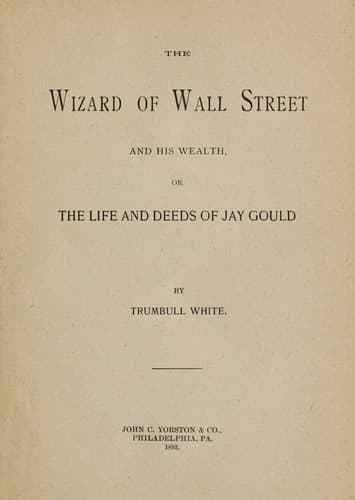
The Wizard of Wall Street and His Wealth; or, The Life and Deeds of Jay Gould — John Shaqi
The Wizard of Wall Street and His Wealth; or, The Life and Deeds of Jay GouldWhite, Trumbull
History
The Wizard of Wall Street and His Wealth; or, The Life and Deeds of Jay Gould
White, Trumbull
Businessmen -- United States -- Biography; Capitalists and financiers -- United States -- Biography; Gould, Jay, 1836-1892
But now let us quote a little plain language from Charles Francis Adams
in order to get into the atmosphere of Erie at this time:
“Yet freebooters are not extinct,” he wrote. “They have only
transferred their operations to the land, and have conducted them in
more or less accordance with the forms of law, until at last so great a
proficiency have they attained that the commerce of the world is more
equally but far more heavily taxed in their behalf than would ever have
entered into their wildest hopes, while outside the law they simply
make all comers stand and deliver. * * * Gambling is a business now,
where formerly it was a disreputable excitement. Cheating at cards
was always disgraceful. Transactions of a similar character under the
euphemistic names of ‘operating,’ ‘cornering’ and the like are not so
regarded. * * * No better illustration of the fantastic disguises which
the worst and most familiar evils of history assume as they meet us in
the actual movement of our own day could be afforded than was seen in
the events attending what are known as the Erie wars of the year 1868.”
In these wars Gould was an active spirit; and if Mr. Adams had written
in 1873 instead of 1869 he would have made his language still stronger.
Before his entrance into Erie Gould had become acquainted with James
Fisk, Jr., and the former, with that unerring judgment of men which
was always one of the elements of his success, soon perceived in Fisk
the qualities which supplied his own deficiencies. Fisk was the son
of a Vermont peddler and followed the calling himself for some time,
and in it learned the great art of driving a hard and shrewd bargain.
Wholly uneducated, his natural ability in the line of making money
was very great. Gould was timid and shrank from publicity. Fisk was
bold and loved notoriety. Gould had many refinements of mind and was
of a domestic nature. Fisk was coarse, sensual and fond of display.
He became the colonel of a militia regiment, and with great delight
used to put on his uniform and ride in front of his command. He used
to create a sensation by riding in a carriage with six horses in
questionable female company. He considered it one of the choisest
prerogatives of his position of vice-president and comptroller of Erie
to direct the theater that adjoined the railway offices in the Grand
Opera House. While Gould did not have the inclination or courage to do
these things he did not hesitate to use Fisk in every available way
and to hide his own personality behind that of his partner. In those
days Fisk seemed to play the more prominent part, and Gould, in public
estimation, was a secondary character. When anything was done it was
Fisk that bore the brunt of popular criticism and indignation. Yet the
facts as they are now known show that Gould’s was the master mind; Fisk
was simply his right arm. “With Gould to plan and Fisk to act,” said
Gen. Francis Barlow, in 1872, “they were a strong team.”
Public-domain text, read in full here on John Shaqi.
Reviews
Reviews
No reviews yet
Be the first to share your thoughts on this work.
Join the Discussion
Join the discussion
Sign in to leave a comment or review.
Sign InorCreate an account