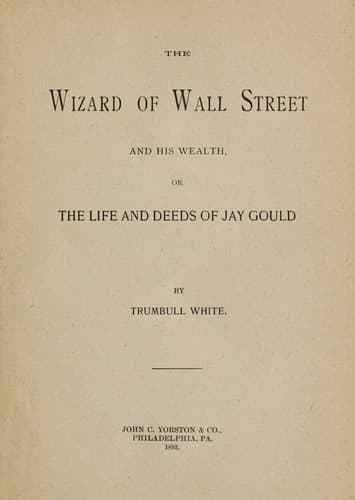
The Wizard of Wall Street and His Wealth; or, The Life and Deeds of Jay GouldWhite, Trumbull
History
The Wizard of Wall Street and His Wealth; or, The Life and Deeds of Jay Gould
White, Trumbull
Businessmen -- United States -- Biography; Capitalists and financiers -- United States -- Biography; Gould, Jay, 1836-1892
At the time Gould and Fisk entered into Erie, Daniel Drew was the
master of that great trunk line. Drew was one of the most extraordinary
characters in Wall street history. Both pious and unscrupulous, he
founded a theological seminary and wrecked a railroad with equal
fervor. He was a director and treasurer of Erie, and used these
positions simply for speculative purposes. He was known in his day as
“the great speculative director.” His biggest piece of “financiering”
was to get himself apparently cornered in Erie stock, and then to
appear in the street with a block of stock which had been converted
from bonds issued with an obscure provision entitling the holders
to convert them into stock. Gould later on repeated this trick with
success, both in Erie and Jersey Central.
Soon after Gould and Fisk entered Erie, Drew became engaged in his
celebrated contest with Commodore Vanderbilt, and in this contest he
had their able assistance. The first and great Vanderbilt was cast in a
larger mould than Drew. The latter was simply a speculator. Vanderbilt
was a creator of property. He was the first of the line of railroad
kings. Laying the foundations of his great wealth in the steamboat and
steamship business, he soon drifted into railroad operations, clearly
seeing that in the development in the great inland commerce of America
there were larger and quicker profits to be obtained than in the export
trade.
Vanderbilt had obtained control of the Harlem and Hudson River roads;
he now aimed at the ownership of Erie. Space will not permit the
telling of the story of this famous contest. It can be found in detail
in Mr. Adams’ interesting chapter. It is a story of extraordinary
stock operations, of millions lost and won; of securities issued by
the bushel and with little or no regard for law or equity; of large
and intricate litigation; of judges bought, legislators bribed, of
directors defying injunctions and fleeing to another state to escape
arrest. Vanderbilt, having been defeated in other efforts to get his
fingers on the Erie road, resolved, if possible, to buy a controlling
interest, and his brokers were set at work on this difficult job.
Drew resolved to let Vanderbilt have as much stock as he wanted, but
entered into a bargain with Gould and Fisk by which the railroad king
should be defeated by issuing and marketing an unlimited number of new
securities. So Drew sold and Vanderbilt bought. The latter, having in
remembrance Drew’s famous convertible stock trick, resorted to the
courts to prevent him from issuing any more stock. Injunctions were
issued enjoining Drew and all the directors of the road from issuing
any stock. Counter-injunctions were obtained by the Drew-Gould party.
One judge would issue an order commanding certain things to be done
which another judge simultaneously commanded should not be done. Judges
in New York, Brooklyn, Albany and Binghamton issued contradictory
injunctions.
Public-domain text, read in full here on John Shaqi.
Reviews
Reviews
No reviews yet
Be the first to share your thoughts on this work.
Join the Discussion
Join the discussion
Sign in to leave a comment or review.
Sign InorCreate an account