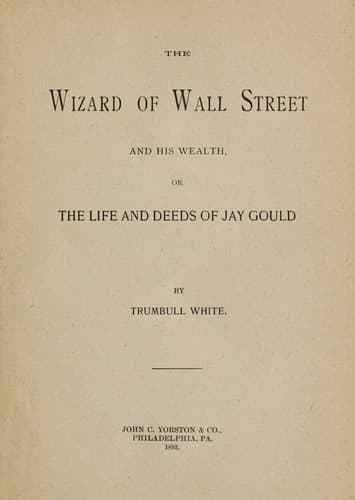
The Wizard of Wall Street and His Wealth; or, The Life and Deeds of Jay Gould — John Shaqi
The Wizard of Wall Street and His Wealth; or, The Life and Deeds of Jay GouldWhite, Trumbull
History
The Wizard of Wall Street and His Wealth; or, The Life and Deeds of Jay Gould
White, Trumbull
Businessmen -- United States -- Biography; Capitalists and financiers -- United States -- Biography; Gould, Jay, 1836-1892
The “Black Friday” scheme was the most gigantic one that Wall street
had ever seen. This gold conspiracy was investigated in 1870 by a
committee of Congress, of which James A. Garfield, afterward President,
was chairman, and S. S. Cox, a member. The investigation undertaken
went far enough to show how zealously the conspirators labored to
get Grant within their toils and implicated persons near to him.
Unfortunately, too, the President had innocently enough permitted
himself to be put in a suspicious position, and it was long before he
was completely purged of the scandal.
The report of the committee, with the accompanying testimony, is
absorbingly interesting:
“Gould, the guilty plotter of all these criminal proceedings,” is the
language of James A. Garfield, the author of this report.
Gould some years before had formed a co-partnership with H. N. Smith
and others under the name of Smith, Gould, Martin & Co. “He was a
broker,” says Henry Adams in his history of the gold conspiracy, “and a
broker is almost by nature a gambler, perhaps the very last profession
suitable for a railway manager. In character he was strongly marked
by his disposition for silent intrigue. He preferred, as a rule, to
operate on his own account without admitting other persons into his
confidence, and he seemed never to be satisfied except when deceiving
everyone as to his intentions. There was a reminiscence of the spider
in his nature. He spun huge webs in corners and in the dark, which
were seldom strong enough to resist a serious strain at the critical
moment. His disposition to this subtlety and elaboration of intrigue
was irresistible. It is scarcely necessary to say that he had not a
conception of a moral principle. In speaking of this class of men, it
must be fairly assumed at the outset that they do not, and can not,
understand how there can be a distinction between right and wrong in
matters of speculation, so long as the daily settlements are punctually
effected. In this respect, Mr. Gould was probably as honest as the mass
of his fellows, according to the moral standard of the street; but
without entering upon technical questions of roguery, it is enough to
say that he was an uncommonly fine and unscrupulous intriguer, skilled
in all the processes of stock gambling, and indifferent to the praise
or censure of society.”
Public-domain text, read in full here on John Shaqi.
Reviews
Reviews
No reviews yet
Be the first to share your thoughts on this work.
Join the Discussion
Join the discussion
Sign in to leave a comment or review.
Sign InorCreate an account