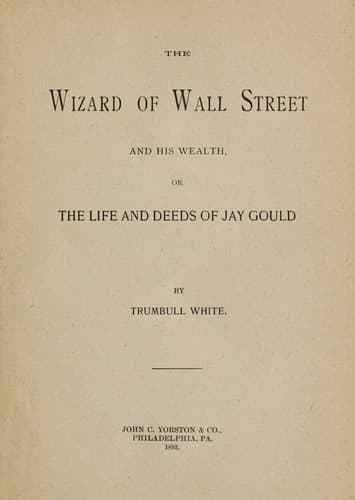
The Wizard of Wall Street and His Wealth; or, The Life and Deeds of Jay GouldWhite, Trumbull
History
The Wizard of Wall Street and His Wealth; or, The Life and Deeds of Jay Gould
White, Trumbull
Businessmen -- United States -- Biography; Capitalists and financiers -- United States -- Biography; Gould, Jay, 1836-1892
It was one of Mr. Gould’s peculiarities that he rarely entered into any
large speculation without furnishing the public with a plausible reason
for assisting him in his operations. This was certainly the case in
the gold conspiracy. The plausible reason was in this case suggested
to Mr. Gould by James McHenry, who was then training with Mr. Gould in
Erie. The latter spared no pains to dress the reason up in the best
shape and give it to the public. Mr. Gould argued with much apparent
force, but actual sophistry, that an advance in the price of gold would
benefit the Western farmers in giving them a bigger price for their
grain, and Mr. Gould backed up this theory with many facts and figures.
Gen. Grant had just become President. His Secretary of the Treasury was
George F. Boutwell. The key to the situation was the financial policy
of the government. No successful corner in gold could be established
if the Treasury should sell gold with a liberal hand. It should be
explained that the war had caused a lively speculation in gold, which
continued after the war until the resumption of specie payments made
the greenbacks equal in value to gold. Speculation in gold was carried
on in the gold-room, an institution separate from the Stock Exchange.
It became essential to the success of Mr. Gould’s plans that the Grant
administration should either become a party to the speculation or else
an honest believer in his crop theory. Failing in both of these, the
public must at least be impressed with the idea that the administration
was in the deal whether it was or not. So Gould began to lay systematic
siege around the administration. He seems to have entered alone into
this speculation. It was only when he was unable to carry the burden
alone that he took in others, and it was not until late in the game
that Fisk entered, Gould found a brother-in-law of President Grant a
convenient tool in his operations. The name of this brother-in-law was
A. R. Corbin, who had been something of an adventurer all his life,
and whose chief hold on respectability was his relationship to the
President. Gould unfolded enough of his plans to Corbin to enlist him
in his service and to bind him by interest to the speculation. Gould
bought for Corbin $1,500,000 of gold, and promised him that all the
profits should be turned over to him. Every rise of one per cent. in
the price of gold made Corbin $15,000 richer. Corbin claimed to have
great influence with the President, and Gould evidently placed much
reliance in him. “I am right behind the throne,” said Corbin to Gould
at one stage of the proceedings. “Give yourself no uneasiness. All is
right.”
Public-domain text, read in full here on John Shaqi.
Reviews
Reviews
No reviews yet
Be the first to share your thoughts on this work.
Join the Discussion
Join the discussion
Sign in to leave a comment or review.
Sign InorCreate an account