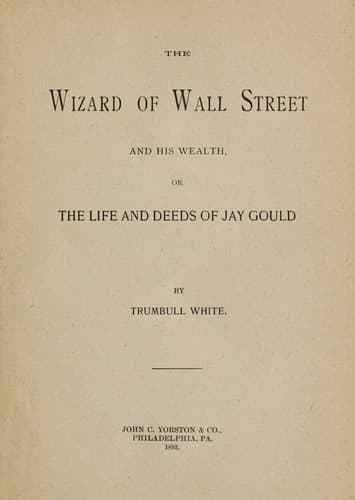
The Wizard of Wall Street and His Wealth; or, The Life and Deeds of Jay GouldWhite, Trumbull
History
The Wizard of Wall Street and His Wealth; or, The Life and Deeds of Jay Gould
White, Trumbull
Businessmen -- United States -- Biography; Capitalists and financiers -- United States -- Biography; Gould, Jay, 1836-1892
The President was to be sounded in regard to his financial policy on
the occasion of this memorable trip to Boston, and when the selected
guests sat down at nine o’clock to supper the conversation was directed
to the subject of finance. “Some one,” says Mr. Gould, “asked the
President what his view was.” The “some one” in question was, of
course, Mr. Fisk, who alone had the impudence to put such an inquiry.
The President bluntly replied that there was a certain amount of
fictitiousness about the prosperity of the country, and that the bubble
might as well be tapped in one way as another. The remark was fatal to
Mr. Gould’s plans and he felt it, in his own words, “as a wet blanket.”
Mr. Fisk, in his testimony, frankly said:
“On our passage over to Boston with Gen. Grant we endeavored to
ascertain what his position in regard to finances was. We went down to
dinner about nine o’clock, intending, while we were there, to have this
thing pretty thoroughly talked up, and, if possible, to relieve him
from any idea of putting the price of gold down.”
Mr. Gould in his testimony said of the President: “He was our guest. At
this supper the question came up about the state of the country, the
crops, and the prospects ahead. The President was a listener; the other
gentlemen were discussing. Some were in favor of Boutwell’s selling
gold, and some were opposed to it. After they had all interchanged
their views, some one asked the President what his view was. He
remarked that he thought there was a certain amount of fictitiousness
about the prosperity of the country, and that the bubble might as well
be tapped in one way as another. That was about the substance of his
remark. He then asked me what I thought about it. I remarked that I
thought if that policy was carried out it would produce great distress,
and almost lead to civil war.”
However, Gould was already in, and he was not a man to back out as long
as he saw any chance for success, and he finally succeeded in really
impressing on the President’s mind that in order to move the crops it
was necessary that gold should sell at 145. Gould’s first purchases
had been made as low as 130¼, which was about the normal price.
But it should be said at the outset that there is not a particle
of evidence that Gen. Grant was ever personally concerned in the
speculation or that he winked at members of his official household
being so. On the contrary, the evidence is all the other way. Grant
never seemed to like Gould. When the latter succeeded in getting his
first interview with the President, Gen. Grant reprimanded his servant
for allowing him so easy an access to his person, and at a later day
the President remarked to his Secretary that he did not like to have
that man--referring to Gould--around so much. “He is always trying to
get something out of me,” was the President’s remark.
Public-domain text, read in full here on John Shaqi.
Reviews
Reviews
No reviews yet
Be the first to share your thoughts on this work.
Join the Discussion
Join the discussion
Sign in to leave a comment or review.
Sign InorCreate an account