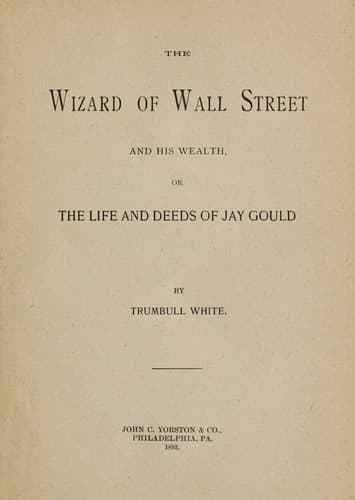
The Wizard of Wall Street and His Wealth; or, The Life and Deeds of Jay GouldWhite, Trumbull
History
The Wizard of Wall Street and His Wealth; or, The Life and Deeds of Jay Gould
White, Trumbull
Businessmen -- United States -- Biography; Capitalists and financiers -- United States -- Biography; Gould, Jay, 1836-1892
This beautiful account of Gould’s devotion to a friend, to the extent
of starting a telegraph company for him, does not, however, tell
the whole story. Gould’s policy in regard to the American Union was
twofold. It was to establish a competing company so strong that the
Western Union would have to absorb it, or else it would absorb the
Western Union. The result was that the Western Union did absorb the
American Union and Gould absorbed the Western Union! By the aid of
his rival company Gould kept hammering at the stock of the Western
Union, then controlled by Vanderbilt. By every art known to Wall street
speculation he forced the price down as low as he could. He sold the
stock “short” in large amounts, and in buying to cover bought enough
additional to place him in control. Then he consolidated the two
companies and 100,000 shares of American Union, which represented a
comparatively small outlay of capital on the part of Gould, went into
the Western Union at par and Gould’s immense holdings of Western Union
were thus acquired at a low figure. Of course, if he had attempted
to market his holdings in one lump his profits would have been wiped
out, but by carrying the load and letting the stock out by driblets
his profits were large, even if he sold under the market price, which
was nearly always below par. On Jan. 11, 1881, it became known in Wall
street that the consolidation was probable and the price of Western
Union rose from 78 to 103 and the next day to 114½. The consolidation
increased the capitalization of the Western Union to $80,000,000,
and this amount has increased later by the capitalization of scrip
dividends and by the acquisition of the Baltimore and Ohio telegraph.
After Gould became the master of the system the Mutual Union was
started as a rival concern. Gould soon gobbled it up and leased it to
the Western Union. Then Robert Garrett developed the wires owned by
the Baltimore and Ohio railroad into a competing telegraph system,
and under the management of Mr. Bates, who had formerly been with
Gould in American Union and Western Union, it became a big system,
stretching far west and south. But Garrett soon got into deep waters.
He had not the genius of his father, the famous John W. Garrett, and
a struggle with Gould was beyond his strength. The Baltimore and Ohio
railroad, nominally a Gibraltar of strength, was intrinsically weak.
Garrett entered into negotiations to sell a controlling interest in
the property. His desire was to place it in hands hostile to Gould,
but the latter used his power in the stock market to frustrate his
plans. Garrett contracted to deliver the control to Henry S. Ives, a
young speculator who was modeling his life after the Gould pattern,
but in the end Garrett was not able to deliver, nor was Ives able to
receive. The B. and O. system was dismembered, and the telegraph fell
into Gould’s hands. Gould had previously announced to the public that
Public-domain text, read in full here on John Shaqi.
Reviews
Reviews
No reviews yet
Be the first to share your thoughts on this work.
Elsewhere in the archive
Join the Discussion
Join the discussion
Sign in to leave a comment or review.
Sign InorCreate an account