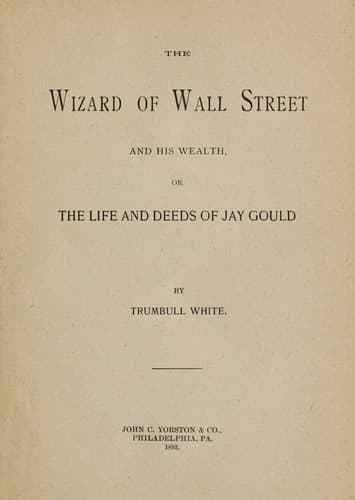
The Wizard of Wall Street and His Wealth; or, The Life and Deeds of Jay GouldWhite, Trumbull
History
The Wizard of Wall Street and His Wealth; or, The Life and Deeds of Jay Gould
White, Trumbull
Businessmen -- United States -- Biography; Capitalists and financiers -- United States -- Biography; Gould, Jay, 1836-1892
“the Western Union does not intend to buy any more rival telegraph
companies,” but when he found he could get the B. and O. cheap, a
little declaration of that kind did not stand in the way. In fact it
was intended only to mask his intention to buy.
Gould drew around him in Western Union a powerful body of men. His
board of directors included Norvin Green, Harrison Durkee, Alonzo B.
Cornell (who when governor of the state from 1880 to 1883 posed as
an anti-Gould and anti-monopoly governor), Cyrus W. Field, Robert L.
Kennedy, Hugh J. Jewett (whose testimony in regard to Erie has already
been quoted), J. Pierpont Morgan, of Drexel, Morgan & Co.; C. P.
Huntington, R. C. Clowry, Henry Weaver, Erastus Wiman, of R. G. Dun &
Co.; John Jacob Astor, Frank Work, George B. Roberts, president of the
Pennsylvania railroad, the leading railroad system of the world; George
D. Morgan, John Hoy, W. D. Bishop and J. W. Clendenin. The management,
however, was in the hands of an executive committee composed of Gould’s
immediate associates. The Western Union, besides its land system, owns
ocean cables and has a big interest in the telephone and stock “ticker”
systems, and Gould’s power as the master of this company can scarcely
be estimated.
It is believed that Mr. Gould’s real ambition, so far as concerned
the Western Union, was to sell it to the government. But so long as
the country believed that Jay Gould desired to sell there could be no
public opinion aroused in favor of purchasing it. So Gould, if such was
his real desire, masked his purpose behind a display of indifference
or opposition, in the hope that if it was thought he did not wish to
sell the country would be all the more eager to buy. Thus he told the
Committee on Labor and Education:
“I think the control by the government is contrary to our institutions.
The telegraph system, of all other business, wants to be managed by
skilled experts, while the government is founded on the idea that
the party in power shall control the patronage. If the government
controlled it the general managers’ heads would come off every four
years and you would not have any such efficient service as at present.
The very dividend of the Western Union is based upon doing business
well, keeping her customers and developing her business. If the
Democrats were in power there would be a Democratic telegraph; if the
Republicans came into power there would be a Republican telegraph, and
if the reformers came in I don’t know what there would be. (Laughter.)
I think it would be a mere political machine. I would be perfectly
willing, so far as I am concerned, to allow the government to try it,
to sell out our property, but it would be very unjust to take it away,
the property of our own citizens, and make it valueless.”
“Have you any idea what the government ought to pay?”
Public-domain text, read in full here on John Shaqi.
Reviews
Reviews
No reviews yet
Be the first to share your thoughts on this work.
Elsewhere in the archive
Join the Discussion
Join the discussion
Sign in to leave a comment or review.
Sign InorCreate an account