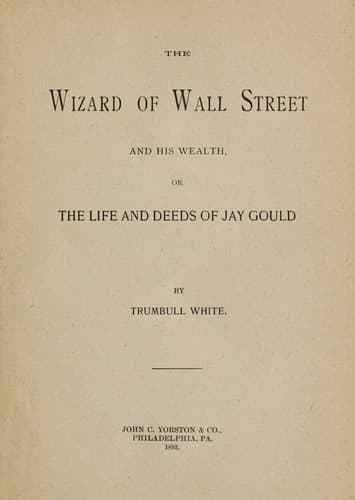
The Wizard of Wall Street and His Wealth; or, The Life and Deeds of Jay GouldWhite, Trumbull
History
The Wizard of Wall Street and His Wealth; or, The Life and Deeds of Jay Gould
White, Trumbull
Businessmen -- United States -- Biography; Capitalists and financiers -- United States -- Biography; Gould, Jay, 1836-1892
[Illustration: GOULD’S BIRTHPLACE, AND HIS PALACE ON THE HUDSON.]
The most dramatic of these was the pommeling of Jay Gould by Major A.
A. Selover in August, 1877. Selover was a Californian, a six-footer,
a blond, muscular and vigorous. He first attained prominence in Wall
street when James R. Keene came East after his successful mining
operations in San Francisco, by which he achieved a fortune of
$8,000,000. Keene was a daring, almost foolhardy stock gambler. He
always played for big stakes and took enormous chances. His success
in San Francisco had been so great that he entered Wall street with
the idea of clearing all before him. He tackled Gould as the biggest
animal in the arena, but found to his sorrow that he had to deal with
a man more able than he, scarcely less daring but far more cautious.
In a few short years Keene’s wealth had dwindled away, and early in
1884 he failed, owing hundreds of thousands of dollars in the shape
of “puts,” “calls” and “straddles.” He dropped at the rate of about a
million dollars a year in Wall street, and no small proportion of this
found its way into the pockets of Gould. Yet Keene at one time was
thought to have outmatched Gould. Selover introduced Keene to Gould,
and acted as go-between for them in certain operations in which both
were interested. Early in 1877 the two men combined forces in one deal.
That is to say, they joined in one enterprise and fought each other
behind each other’s back. It was a case of diamond cut diamond. Keene
formed a big pool, and, beginning to fight Gould, finally went over to
him, being led into this change largely through the instrumentality
of Selover. Both Keene and Selover then operated on an understanding
with Gould, but soon found, as they charged, that Gould was secretly
selling them out. Gould and Keene had a stormy scene in Russell
Sage’s office, when the latter is said to have brandished a pistol
in Gould’s face. The deal had been mainly in Western Union, which
Gould did not then control, and Atlantic and Pacific, which he did
control. Gould’s double-dealing not only made Keene very mad, but made
Selover very desperate. He had placed reliance in Gould’s statements
and had suffered loss, and resolved upon revenge. Accordingly, on the
2d of August, 1877, while walking down Exchange place from Broadway,
Selover, meeting Gould walking up to the office of Belden & Co., No.
80 Broadway, of which he was then a partner, first engaged him in
what appeared to be an amicable conversation, but soon resulted in an
assault. Selover first struck Gould in the face and then dropped him
over an areaway at No. 65 Exchange place, which was seven or eight feet
deep. Mr. Gould was a good deal shaken up, but not seriously injured.
Selover left to go to his brokers and Gould proceeded to transact his
business as usual. He was assisted from the areaway, singularly enough,
by George Crouch, who has been identified with several incidents in
Public-domain text, read in full here on John Shaqi.
Reviews
Reviews
No reviews yet
Be the first to share your thoughts on this work.
Elsewhere in the archive
Join the Discussion
Join the discussion
Sign in to leave a comment or review.
Sign InorCreate an account