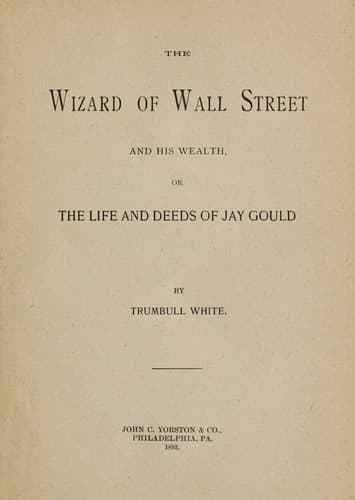
The Wizard of Wall Street and His Wealth; or, The Life and Deeds of Jay GouldWhite, Trumbull
History
The Wizard of Wall Street and His Wealth; or, The Life and Deeds of Jay Gould
White, Trumbull
Businessmen -- United States -- Biography; Capitalists and financiers -- United States -- Biography; Gould, Jay, 1836-1892
Gould’s career from the days of Erie and Black Friday to the Kansas
Pacific criminal prosecution, and who was one-third artist, one-third
newspaper man and one-third speculator. The Selover incident created
an immense sensation at the time, and the newspapers printed columns
about it. Selover became quite a hero, for while there was nothing very
courageous in his assault from a physical point of view, as he was more
than a match for timid Mr. Gould, yet to attack Gould was considered
by many an act of moral bravery. Selover declared that he had attacked
Gould because Gould had been guilty of fraud, lying and duplicity.
Gould, he said, had made arrangements with him to go short on Western
Union, and while he (Selover) was selling accordingly in good faith
he discovered that Gould was buying heavily. When he learned of this
he determined to punish him the first time he met him, and so he had
charged him with the fraud and slapped his face. “I attacked him on my
own account alone,” he added, “and regardless of the fact that he had
played Jim Keene the same trick. He is notoriously treacherous, and
this is not the first time he has been punished for the same offense.”
Poor Mr. Selover never amounted to very much in Wall street after this,
though he continued to be seen there daily. Gould, after this incident,
rarely appeared in the street unless accompanied by stalwart G. P.
Morosini.
It is related that not long after this Keene came near getting his
revenge on Gould. The latter was putting all his energies into Union
Pacific, and carrying $22,000,000 of the stock, mostly in margins.
Keene organized an opposition party and nearly succeeded in breaking
Gould. Sage, however, came to the latter’s assistance with $2,000,000
of much-needed cash, and Gould was saved. Keene’s purpose was to drive
Gould from the street forever, but he not only failed, but in a few
years he was himself a bankrupt, with Gould more powerful and richer
than ever.
Rumors of Gould’s death and of his impending bankruptcy were not
infrequently circulated in Wall street. Rumors of death could be easily
disproved, but once, at least, the street was firmly convinced that
Gould was in financial difficulties, and Gould was obliged to exhibit
his wealth in order to prove that he was solvent. On March 13, 1882,
Gould exhibited to Sage, Field and Frank Work his box of securities,
to show that he was not only solid, but also had not been a seller of
stocks. He exhibited to the astonished vision of these associates
$23,000,000 of Western Union, $12,000,000 of Missouri Pacific, and
$19,000,000 of other stocks. Russell Sage said: “There is not another
man in America except Vanderbilt who could make such a display of stock
as that.” In 1884 Gould made another exhibition of his securities to
John T. Terry and others, and the display was even bigger than two
years before.
Public-domain text, read in full here on John Shaqi.
Reviews
Reviews
No reviews yet
Be the first to share your thoughts on this work.
Elsewhere in the archive
Join the Discussion
Join the discussion
Sign in to leave a comment or review.
Sign InorCreate an account