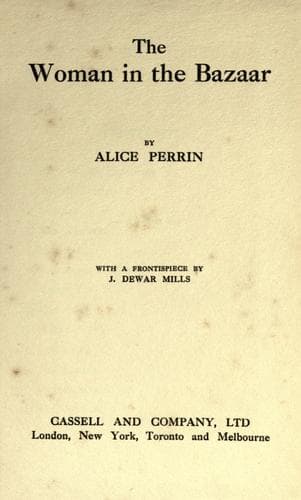
British -- India -- Fiction; India -- Social life and customs -- Fiction
On their way back to their bungalow there was silence between the
Coventrys. They were driving in the cab of the country, a rough vehicle
that resembled a palanquin on wheels, with venetian shutters instead of
windows, and the noise it made would have rendered even the most amiable
of conversations impossible. The air outside was warm and still, and the
rattle of the wheels and the woodwork, and the clumsy harness, seemed
intensified by the surrounding silence of the Indian night. The stuffy
conveyance was filled with the scent of violets--lately Rafella had
taken to scent, strong scent that clung and impregnated everything she
wore. At her breast was a cluster of violets that had come from the pots
in Mr. Kennard's veranda, and now, dying, the flowers gave out a stale
fragrance. To the angry man at her side the concentrated perfume was
atrocious. It seemed to be connected in some subtle way with the
alteration in his wife's behaviour--to breathe of all that was false and
worthless in a woman's heart. Bitterly he blamed the follies and
temptations of Indian life, and her failure to withstand them. It did
not occur to him that, with her limited intelligence, her inexperience
of life, and her undeveloped outlook, things would have been the same in
any quarter of the earth, given the scope and opportunity. He was a man
who could not make allowances, who could perceive no point of view
except his own; yet withal he was a straight and honourable English
soldier, with high standards of right and wrong, and a deep sense of the
sanctity of marriage. Such people are often incapable of distinguishing
between mere foolishness and sin; they will argue that there are no
degrees of infidelity, and that a false step necessarily implies
complete downfall. Coventry had no sympathy with sexual temptation; in
his sight, if a married woman permitted a man who was not her husband to
make love to her, she was guilty of more than indiscretion.
His anger kept him silent as they entered their bungalow. He was afraid
to trust himself to speak.
It was his wife who precipitated the storm; she turned up the lamp that
was burning low on a table in the drawing-room, and threw her cloak on
to a chair with a petulant movement. The atmosphere of the room was
oppressive, yet Coventry had re-bolted the long glass door by which they
had entered. Mosquitoes, disturbed by the light, flew with thin
screamings around their heads.
Public-domain text, read in full here on John Shaqi.
Reviews
Reviews
No reviews yet
Be the first to share your thoughts on this work.
Join the Discussion
Join the discussion
Sign in to leave a comment or review.
Sign InorCreate an account