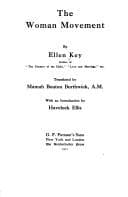
It is at this stage that Ellen Key comes before us with her book on _The
Woman’s Movement_, first published in Swedish in 1909, and now presented
to the reader in English. As Ellen Key views the Woman’s Movement, it
certainly includes all that those who struggle for votes for women are
fighting for; she is unable to see, as she puts it, why a woman’s hands
need be more soiled by a ballot paper than by a cooking recipe. But she
is far indeed from the well-intentioned but ignorant fanatics who fancy
that the vote is the alpha and the omega of Feminism; and still less is
she in sympathy with those who consider that its importance is so
supreme as to justify violence and robbery, a sort of sex war on mankind
generally, and the casting in the mud of all those things which it has
been the gradual task of civilisation to achieve, not for men only but
for women. The Woman’s Movement, as Ellen Key sees it, includes the
demand for the vote, but it looks upon the vote merely as a reasonable
condition for attaining far wider and more fundamental ends. She is of
opinion that the Woman’s Movement will progress less by an increased
aptitude to claim rights than by an increased power of self-development,
that it is not by what they can seize, but by what they are, that women,
or for the matter of that men, finally count. She regards the task of
women as constructive rather than destructive; they are the architects
of the future humanity, and she holds that this is a task that can only
be carried out side by side with men, not because man’s work and woman’s
work is, or should be, identical, but because each supplements and aids
the other, and whatever gives greater strength and freedom to one sex
equally fortifies and liberates the other sex.
Certainly we may not all agree with Ellen Key at every point, nor always
accept her interpretation of the great movement of which she is so
notable a pioneer. The breadth of her sympathies may sometimes seem to
lead to an impracticable eclecticism, and, in the rejection of narrow
and trivial aims, she may too sanguinely demand an impossible harmony of
opposing ideals. But if this is an error it is surely an error on the
right side. She has not put forward this book as a manifesto of the
advanced guard of the Woman’s Movement, but merely as the reflections of
an individual woman who, for nearly half a century, has pondered, felt,
studied, observed this movement in many parts of the world. But it would
not be easy to find a book in which the claims of Feminism—in the
largest modern sense—are more reasonably and temperately set forth.
[Signature: _Havelock Ellis._]
LONDON, May 1, 1912.
CONTENTS
PAGE
INTRODUCTION 1
CHAPTER
I THE EXTERNAL RESULTS OF THE WOMAN MOVEMENT 23
Public-domain text, read in full here on John Shaqi.
Reviews
Reviews
No reviews yet
Be the first to share your thoughts on this work.
Join the Discussion
Join the discussion
Sign in to leave a comment or review.
Sign InorCreate an account