II THE INNER RESULTS OF THE WOMAN MOVEMENT 58
III THE INFLUENCE OF THE WOMAN QUESTION UPON SINGLE WOMEN 71
IV THE INFLUENCE OF THE WOMAN MOVEMENT UPON THE DAUGHTERS 89
V THE INFLUENCE OF THE WOMAN MOVEMENT UPON MEN AND WOMEN IN 111
GENERAL
VI THE INFLUENCE OF THE WOMAN MOVEMENT UPON MARRIAGE 139
VII THE INFLUENCE OF THE WOMAN MOVEMENT UPON MOTHERHOOD 169
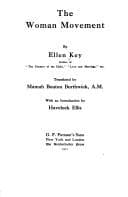
The Woman Movement
INTRODUCTION
The first “woman movement” was Eve’s gesture when she reached for the
fruit of the Tree of Knowledge—a movement symbolic of the entire
subsequent woman’s movement of the world. For the will to pass beyond
established bounds has constantly been the motive of her conscious as
well as of her subconscious quest. Every generation has called this
transgression, this passing beyond the bounds, a “fall of man,” the
“original sin,” a crime against God’s express command, a crime against
the nature of woman as prescribed for her for all time.
And yet from the beginning women have appeared who have passed far
beyond the established boundaries set for their sex by their era and
upheld by their own people. They have demonstrated that limitations thus
prescribed do not always coincide with what is considered by the
majority to be the “nature” of woman. At one time a woman has manifested
the “masculine” characteristics of a ruler or has performed a
“masculine” deed; at another time she has distinguished herself in
“masculine” learning or art, or again has dared to love without the
permission of law and custom. In a word the individual woman, when her
head or her heart was strong enough, has always shown the possibilities
of the development of personal power. But she has had in that effort
only her own strength and her own will upon which to rely; she has
neither been urged on by the spirit of her time (_Zeitgeist_) nor been
emulated by the masses. Exceptional women have sometimes been glorified
by their contemporaries and by posterity as “wonders of nature”;
sometimes been cited as “warning examples.” Seen in connection with the
world’s woman movement all these instances, where a bond was broken by
woman’s power of mind or creative gift, by a heart or a conscience, are
parts of what can be called the “prehistoric” woman movement. This
movement for personal freedom formed no step in that phase of the
development which possesses a conscious purpose, but was merely
sporadic. Even so the participation was long nameless which women took
in the great struggles for freedom where, without consideration for the
“nature” of woman, they dared bleed upon the arena and scaffold, ascend
the pyre, and be raised upon the gibbet. Very rarely did these women
martyrs alter immediately men’s—or even women’s—conception of woman’s
“being.” But just as many perfumes are dissipated only after centuries,
Public-domain text, read in full here on John Shaqi.
Reviews
Reviews
No reviews yet
Be the first to share your thoughts on this work.
Join the Discussion
Join the discussion
Sign in to leave a comment or review.
Sign InorCreate an account