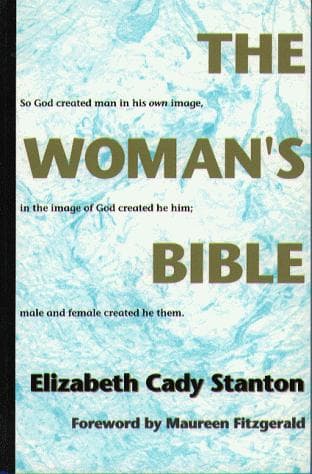
Bible -- Commentaries; Bible -- Feminist criticism; Women in the Bible
Before the sacred canon of the Old Testament was written there were
Prophets who took the place of Bibles to the Church. It is said that
God himself spake to the children of Israel from the top of Mount
Sinai, but that it was so terrible they entreated the Lord ever after
to speak to them through men. So ever after he did communicate with
them through Prophets and Angels. Isaiah was of the royal family;
he was nephew to King Uzziah. The Prophet in the above texts reproves
and warns the daughters of Zion and tells them of their faults. He does
not like their style of walking, which from the description must have
been much like the mincing gait of some women to-day.
The Prophet expressly vouches God's authority for what he said
concerning their manners and elaborate ornamentation, lest they should
be offended with his criticisms. If the Prophets could visit our stores
and see all the fashions there are to tempt the daughters of to-day,
they would declaim against our frivolities on the very doorsteps, and
in view of the Easter bonnets, at the entrance to our churches. The
badges which our young women wear as members of societies, pinned in
rows on broad ribbons, the earrings, the bangles, the big sleeves, the
bonnets trimmed with osprey feathers, answer to the crisping pins, the
wimples, the nose jewels, the tablets, the chains, the bracelets, the
mufflers, the veils, the glasses and the girdles of the daughters of
Zion. If the Prophets, instead of the French milliners and dressmakers,
could supervise the toilets of our women, they would dress in far
better taste.
DANIEL.
The name of this Prophet in Hebrew was "Da##il,"[FN#5] which
signifies "the judgment of God." His Chaldean name was Bethshazzai. He
was of the tribe of Judah of the royal family. Josephus calls him one
of the greatest of the Prophets.
[FN#5] Redactor's note. Text was illegible.
Daniel v.
Belshazzar the king made a great feast and commanded to bring the
golden and silver vessels which his father Nebuchadnezzar had taken out
of the temple which was in Jerusalem; that the king and his princes,
his wives and his concubines, might drink therein.
3 Then they brought the golden vessels, . . . and praised the gods of
gold, and of silver, of brass, of iron, of wood, and of stone.
5 In the same hour came forth fingers of a man's hand, and wrote over
against the candlestick upon the plaster of the wall: and the king saw
the part of the hand that wrote.
6 Then the king's countenance was changed, and his thoughts troubled
him, so that his knees smote one against another.
7 The king cried aloud to bring in the astrologers, the Chaldeans, and
the soothsayers. And the king spoke, and said to the wise men of
Babylon, Whosoever shall read this writing, and shew
me the interpretation thereof, shall be clothed with scarlet, and have
a chain of gold about his neck, and shall be the third ruler in the
kingdom.
Public-domain text, read in full here on John Shaqi.
Reviews
Reviews
No reviews yet
Be the first to share your thoughts on this work.
Elsewhere in the archive
Join the Discussion
Join the discussion
Sign in to leave a comment or review.
Sign InorCreate an account