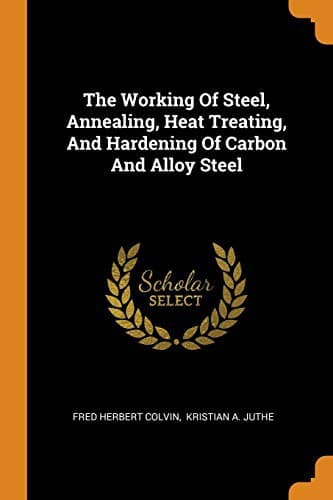
The Working of Steel: Annealing, Heat Treating and Hardening of Carbon and Alloy Steel — John Shaqi
The Working of Steel: Annealing, Heat Treating and Hardening of Carbon and Alloy SteelColvin, Fred H. (Fred Herbert)
Science
The Working of Steel: Annealing, Heat Treating and Hardening of Carbon and Alloy Steel
Colvin, Fred H. (Fred Herbert)
Steel
Sulphur is of most trouble to rolling and forging operations when
conducted at a red heat. It makes steel tender and brittle at that
temperature--a condition known to the workmen as "red-short." It
seems to have little or no effect upon the physical properties
of cold steel--at least as revealed by the ordinary testing
machines--consequently many specifications do not set any limit
on sulphur, resting on the idea that if sulphur is low enough not
to cause trouble to the manufacturer during rolling, it will not
cause the user any trouble.
Tool steel and other fine steels should be very low in sulphur,
preferably not higher than 0.03 per cent. Higher sulphur steels
(0.06 per cent, and even up to 0.10 per cent) have given very good
service for machine parts, but in general a high sulphur steel
is a suspicious steel. Screw stock is purposely made with up to
0.12 per cent sulphur and a like amount of phosphorus so it will
cut freely.
Manganese counteracts the detrimental effect of sulphur when present
in the steel to an amount at least five times the sulphur content.
PHOSPHORUS is an element (symbol P) which enters the metal from
the ore. It remains in the steel when made by the so-called acid
process, but it can be easily eliminated down to 0.06 per cent
in the basic process. In fact the discovery of the basic process
was necessary before the huge iron deposits of Belgium and the
Franco-German border could be used. These ores contain several
per cent phosphorus, and made a very brittle steel ("cold short")
until basic furnaces were used. Basic furnaces allow the formation
of a slag high in lime, which takes practically all the phosphorus
out of the metal. Not only is the resulting metal usable, but the
slag makes a very excellent fertilizer, and is in good demand.
SILICON is a very widespread element (symbol Si), being an essential
constituent of nearly all the rocks of the earth. It is similar to
carbon in many of its chemical properties; for instance it burns
very readily in oxygen, and consequently native silicon is unknown--it
is always found in combination with one or more other elements.
When it bums, each atom of silicon unites with two atoms of oxygen
to form a compound known to chemists as silica (SiO2), and to the
small boy as "sand" and "agate."
Iron ore (an oxide of iron) contains more or less sand and dirt
mixed in it when it is mined, and not only the iron oxide but also
some of the silicon oxide is robbed of its oxygen by the smelting
process. Pig iron--the product of the blast furnace--therefore
contains from 1 to 3 per cent of silicon, and some silicon remains
in the metal after it has been purified and converted into steel.
Public-domain text, read in full here on John Shaqi.
Reviews
Reviews
No reviews yet
Be the first to share your thoughts on this work.
Join the Discussion
Join the discussion
Sign in to leave a comment or review.
Sign InorCreate an account