Presbyterian Church -- Sermons; Sermons, English; Theology -- Early works to 1800; Theology -- History -- 17th century
An Useful Case Of Conscience
That There Is A Malignant Party Still In The Kingdom.
That The Present Public Resolutions, Expressed In The Commission’s
Answer To The Parliament’s Query, And The Act Of The Levy, Do Not
Exclude That Party.
That The Employing Of, And Associating With The Malignant Party,
According As Is Contained In The Public Resolutions, Is Sinful And
Unlawful.
That It Is Not Lawful For The Well Affected Subjects To Concur In Such
An Engagement In War, And Associate With The Malignant Party.
Scriptures Showing The Sin And Danger Of Joining With Wicked And
Ungodly Men.
A Treatise Of Christian Love.
To The Reader.
Chapter I.
Chapter II.
Chapter III.
Chapter IV.
Chapter V.
Several Sermons Upon The Most Important Subjects Of Practical Religion.
The Publisher To The Reader.
Sermon I.
Sermon II.
Sermon III.
Sermon IV.
Sermon V.
Sermon VI.
Sermon VII.
Sermon VIII.
Sermon IX.
Sermon X.
Sermon XI.
Sermon XII.
Sermon XIII.
Sermon XIV.
Sermon XV.
Sermon XVI.
Sermon XVII.
Sermon XVIII.
Sermon XIX.
Sermon XX.
Sermon XXI.
Sermon XXII.
Footnotes
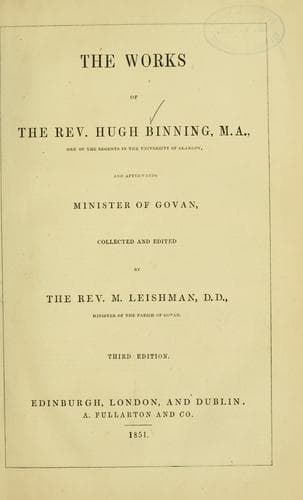
The Works Of
The Rev. Hugh Binning, M.A.,
One of the Regents in the University of Glasgow,
And Afterwards
Minister of Govan
Collected and Edited
by
The Rev. M. Leishman, D.D.,
Minister of the Parish of Govan
NOTANDA.
The following Notes, by the Editor, ought to have been inserted at the
foot of their respective pages.
Page 1, line 25
Nulla est tam facilis res, quin difficilis siet, Quam invitus
facias—_Terent. Heaut._ iv, vi. 1
“There is nothing so easy, as not to become difficult should you do it
unwillingly.”
P. 1, l. 35. Nam illud verum est M. Catonis oraculum, nihil agendo,
homines male agere discunt. “For that is a true oracle of M. Cato—by doing
nothing, men learn to do ill.”—_Columel._ lib. xi, cap. 1.
P. 5, last line. Ει γουν αηδων ημην, εποιουν τα της αηδονος, ει κυκνος, τα
του κυκνου, νυν δε λογικος ειμι, ὑμνειν με δει τον θεον. “Were I a
nightingale, I would perform the office of a nightingale, or a swan, that
of a swan; but since I am a rational creature, it is right that I should
celebrate the praises of God.”—_Epictet. Dissert._ lib. i, cap. 16.
P. 7, l. 53. Quidam vivere tunc incipiunt, cum desinendum est. Si hoc
judicas mirum, adjiciam quod magis admireris, quidam ante vivere
defecerunt, quam inciperent. “Some then begin to live when they are near
the close of life. If you think this wonderful, I will add what you will
wonder at still more, some have ceased to live before they have begun to
live.”—_Senec. Epist._ xxiii.
P. 9, l. 18. Cicero represents the saying— _Amicorum omnia communia_
(Friends have all things in common)—to be a Greek proverb—_De Offic._ lib.
i, cap. xvi.
Public-domain text, read in full here on John Shaqi.
Reviews
Reviews
No reviews yet
Be the first to share your thoughts on this work.
Join the Discussion
Join the discussion
Sign in to leave a comment or review.
Sign InorCreate an account