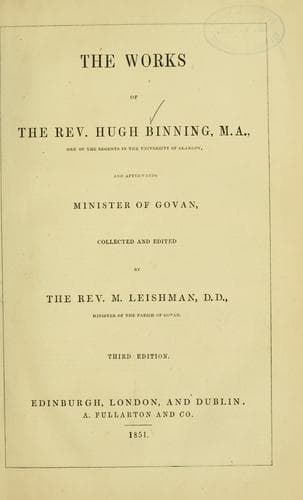
Presbyterian Church -- Sermons; Sermons, English; Theology -- Early works to 1800; Theology -- History -- 17th century
P. 12, l. 50. Ubi in contrarium ducit, ipsa velocitas majoris intervalli
causa fit. “When it leads to an opposite direction, velocity becomes
itself the cause of a wider separation.”—_Senec. De Vita Beata_, cap. i.
P. 13. l. 7. At hic, tritissima quæque via, et celeberrima, maxime
decipit. “But here, every path that is most beaten, and most famous,
deceives most.”—_Ibid._
P. 13. l. 16.—pergentes, non qua eundum est, sed qua itur—“proceeding, not
where we ought to go, but where others go.”_—Ibid._
P. 15, l. 30.
Aut prodesse volunt, aut delectare—_Hor. Ars Poet._, v. 333.
“They wish either to improve or delight.”
P. 16, l. 6.
Omne tulit punctum, qui miscuit utile dulci—_Id._, v. 343.
“Profit and pleasure them to mix with art
Shall gain all votes.”—_Francis Translation_
P. 37, l. 4.
Pluris est oculatus testis unus quam auriti decem
Qui audiunt audita dicunt, qui vident plane sciunt—_Plaut. Trucul._ ii.
vi. 8.
“One eye witness is worth more than ten witnesses who speak by hearsay.
They who hear tell what they hear, they who see have a perfect knowledge
of what occurs.”
P. 37, l. 50. The title πολυωνυμος (distinguished by many names) was
often applied by the Greeks to the principal object of their idolatrous
worship. Cleanthes begins his Hymn to Jove in this way,—
κυδιστ᾽ αθανατων πολυωνυμε
“Most illustrious of the immortals, having many names”
The Ethiopians believed that there was one God, who was the cause of all
things, but they also reverenced another God, whom they supposed to be
inferior to him, and to have _no name_ (ανωνυμον)—;_Strab. Geog._ lib.
xvii, p. 822.
P. 37, l. 52 Quid est Deus? Quod vides totum, et quod non vides totum.
“What is God? Every thing which you see, and every thing which you do not
see.”—_Senec. Nat. Quest._, lib. i.
P. 38, l. 15 The author of the Asclepian Dialogue, uses _unus omnia_
(one-all things) and _Creator omnium_ (the Creator of all things,) as
equivalent expressions—_Cudworth’s Intellectual System_, vol. i. p. 346.
P. 55, l. 44 God was represented by some of the ancient philosophers to
be “the soul of the world, and the soul of the souls of the world.”
P. 79, l. 4, and 8
Prudens futuri temporis exitum
Caliginosa nocte premit Deus,
Ridetque, si mortalis ultra
Fas trepidat—_Hor. Carm._ lib. iii. Ode 29.
"Future events wise Providence
Hath hid in night from human sense,
To narrow bounds our search confined
And laughs to see proud mortals try
To fathom deep eternity,
With the short line and plummet of their mind."
_Creech’s Translation_
P. 164, l. 37
Ουδε γαρ ὁ Ζευς
Ουθ᾽ ὑων παντας ἁνδανει ουτ᾽ ανεχων
_Theognidis Sententiæ_ v. 25.
PREFACE BY THE EDITOR.
Public-domain text, read in full here on John Shaqi.
Reviews
Reviews
No reviews yet
Be the first to share your thoughts on this work.
Join the Discussion
Join the discussion
Sign in to leave a comment or review.
Sign InorCreate an account