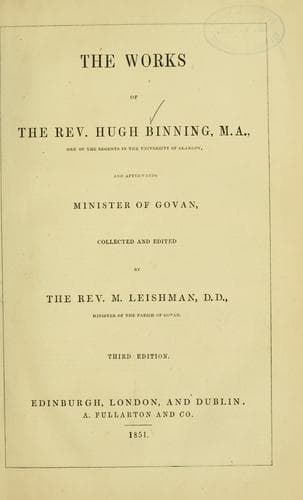
Presbyterian Church -- Sermons; Sermons, English; Theology -- Early works to 1800; Theology -- History -- 17th century
accept freely that which is thus so freely proffered. “I think,” he says,
“a man should seek nothing in himself whereupon to build his coming to
Christ. Though it be true, no man can come to a Saviour, till he be
convinced of sin and misery, yet no man should seek convictions, as a
warrant to come to Christ for salvation. He that is in earnest about this
question, how shall I be saved?—I think he should not spend the time in
reflecting on, and examination of himself, till he find some thing
promising in himself, but, from discovered sin and misery, pass
straightway over to the grace and mercy of Christ, without any intervening
search of something in himself to warrant him to come. There should be
nothing before the eye of the soul but sin and misery and absolute
necessity, compared with superabounding grace and righteousness in Christ,
and thus it singly devolves itself over upon Christ, and receives him as
offered freely, ‘without money and without price.’ I know it is not
possible that a soul can receive Christ, till there be some preparatory
convincing work of the law, to discover sin and misery. But I hold, that
to look to any such preparation, and fetch an encouragement or motive
therefrom, to believe in Christ, is really to give him a price for his
free waters and wine, it is to mix in together, Christ and the law, in the
point of our acceptation. And for souls to go about to seek preparations
for a time, resolving not at all to consider the promise of the gospel,
till they have found them, and satisfaction in them, is nothing else but
to go about to establish their own righteousness, being ignorant of the
righteousness of Christ.”(57)
Public-domain text, read in full here on John Shaqi.
Reviews
Reviews
No reviews yet
Be the first to share your thoughts on this work.
Join the Discussion
Join the discussion
Sign in to leave a comment or review.
Sign InorCreate an account