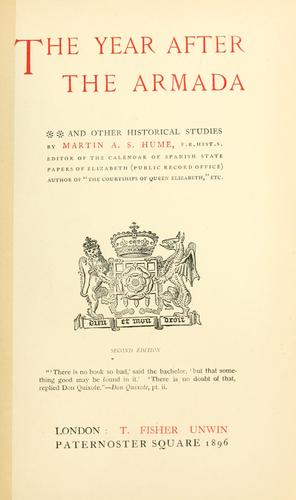
The Year after the Armada, and Other Historical StudiesHume, Martin A. S. (Martin Andrew Sharp)
Philosophy
The Year after the Armada, and Other Historical Studies
Hume, Martin A. S. (Martin Andrew Sharp)
Armada, 1588; Europe -- History -- 1517-1648; Europe -- History -- 17th century
From the first page to the last the writer refers to Danes Court, near
Deal, as the home of his brother, and he himself passes the intervals
of his dissolute life in London in visits to his Kentish kinsman. Now
Danes Court had been for centuries in the possession of the ancient
family of Fogge, and I at once concluded that the writer of my diary
was a younger member of the house. Indeed, encouraged therein by
Hasted, the great authority on Kentish history, I went so far as to
establish to my own entire satisfaction that the diarist was a certain
Captain Christopher Fogge, R.N., who died in 1708, and was buried in
Rochester Cathedral, and I was confirmed in this belief by the fact
that the wind and weather of each day is carefully recorded as in a
sailor's log-book. But somehow it did not fit in. Constant reference
is made to a brother Francis, and no amount of patient investigation in
county genealogies and baptismal certificates could unearth any one
named Francis Fogge. So I had to hark back and try another clue.
Brother Francis was evidently a clergyman and a graduate of King's
College, Cambridge, and towards the end of the diary the author visits
him at the village of Prescot, near Liverpool.
Sure enough the rich living of Prescot was in the gift of King's
College, Cambridge, and further inquiry soon showed that a certain
Francis Bere, M.A., was rector from 1700 until his death in 1722. This
of itself was not much, but it led to further clues which proved the
monumental Hasted {348} ("History of Kent") to be hopelessly wrong
about the Fogge pedigree and the ownership of Danes Court at the time,
and the whole question was settled more completely than I could have
hoped by the discovery, in the "Transactions of the Kent Archæological
Society for 1863," of a copy of the copious memoranda in the old family
Bible, written by the stout cavalier, Richard Fogge, and his son John,
with the notes attached thereto by Warren, the Kentish antiquary in
1711, in which the family history is made clear. This was good as far
as it went, and proved the surname and parentage of the author of the
diary, but did not identify him personally. Certain references in the
manuscript, however, sent me searching amongst the Treasury Papers in
the Record Office, and there I found a set of papers written in the
same cramped, finnicking hand as the diary, which set my mind at rest,
and proved beyond doubt or question who was the methodical rake that
indiscreetly confided the secret of his "goings on" to the incomplete
oblivion of the Spanish tongue.
Public-domain text, read in full here on John Shaqi.
Reviews
Reviews
No reviews yet
Be the first to share your thoughts on this work.
Elsewhere in the archive
Join the Discussion
Join the discussion
Sign in to leave a comment or review.
Sign InorCreate an account