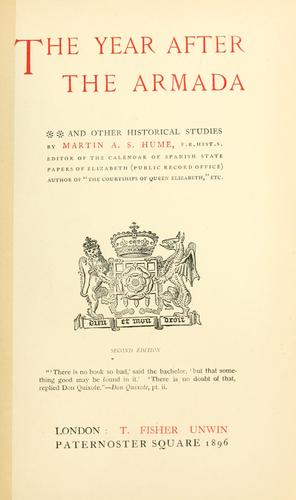
The Year after the Armada, and Other Historical StudiesHume, Martin A. S. (Martin Andrew Sharp)
Philosophy
The Year after the Armada, and Other Historical Studies
Hume, Martin A. S. (Martin Andrew Sharp)
Armada, 1588; Europe -- History -- 1517-1648; Europe -- History -- 17th century
The writer of the diary was one Richard Bere, whose father was rector
of Ickenham, near Uxbridge, and who was born at Cowley, near there, on
the 28th of August, 1653. His sister Elizabeth had married in 1679
John Fogge, who subsequently succeeded to the Danes Court Estate, and,
on the fly-leaf of the Fogge family Bible referred to, John Fogge, who
was evidently proud of the connection, sets forth that his wife's
grandfather had been "Receiver General of ye Low Countries; her uncles,
one of them was in a noble imploy in ye C Clarke's office, ye other
being {349} one of ye clarkes of ye signet to King Charles II., a man
acquainted with all Xtian languages. Ye other now alive is rector of
Bendropp in Gloucestershire, who has an Estate. Her mother was one of
ye family of Bland, of London, eminent merchants at Home and Abroad."
Richard Bere was born only a year after his sister, so that the
statement as to her relatives will hold good for him also. He had been
Collector of Customs at Carlisle, but apparently had allowed his
Jacobite leanings to be too evident, and had been dismissed from his
office a short time before he began the diary, leaving his accounts at
Carlisle still unbalanced and in arrear. How he learnt Spanish I do
not know, but he had evidently been in Spain before his appointment to
Carlisle, probably in the navy, or in some way connected with shipping,
as, in addition to the careful noting of the wind and weather all
through the diary, he shows great interest in the naval events of his
time. His uncle's remarkable proficiency in "all Xtian tongues" may
also perhaps partly explain his own knowledge of the Spanish language.
His family in old times had been a wealthy and powerful one, seated at
Gravesend, Dartford, and Greenhithe in Kent, but had lost its county
importance long before the date of the diary. The widow of one of his
uncles, however, still lived at Gravesend at the time he wrote, and one
of his father's sisters, who had married a man named Childs, also lived
in the neighbourhood, and on her husband's death went to live with her
niece at Danes Court.
Public-domain text, read in full here on John Shaqi.
Reviews
Reviews
No reviews yet
Be the first to share your thoughts on this work.
Elsewhere in the archive
Join the Discussion
Join the discussion
Sign in to leave a comment or review.
Sign InorCreate an account