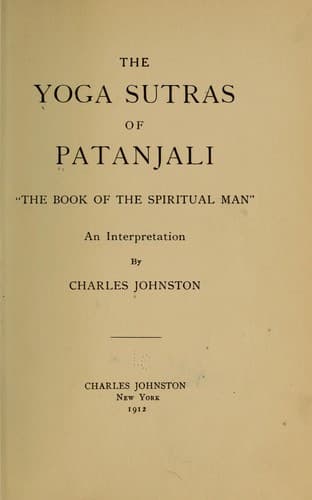
The Yoga Sutras of Patanjali: The Book of the Spiritual ManPatañjali
Religion
The Yoga Sutras of Patanjali: The Book of the Spiritual Man
Patañjali
Yoga -- Early works to 1800
Newton was asked how he made his discoveries. By intending my mind on
them, he replied. This steady pressure, this becoming one with what we
seek to understand, whether it be atom or soul, is the one means to
know. When we become a thing, we really know it, not otherwise.
Therefore live the life, to know the doctrine; do the will of the
Father, if you would know the Father.
41. When the perturbations of the psychic nature have all been stilled,
then the consciousness, like a pure crystal, takes the colour of what
it rests on, whether that be the perceiver, perceiving, or the thing
perceived.
This is a fuller expression of the last Sutra, and is so lucid that
comment can hardly add to it. Everything is either perceiver,
perceiving, or the thing perceived; or, as we might say, consciousness,
force, or matter. The sage tells us that the one key will unlock the
secrets of all three, the secrets of consciousness, force and matter
alike. The thought is, that the cordial sympathy of a gentle heart,
intuitively understanding the hearts of others, is really a
manifestation of the same power as that penetrating perception whereby
one divines the secrets of planetary motions or atomic structure.
42. When the consciousness, poised in perceiving, blends together the
name, the object dwelt on and the idea, this is perception with
exterior consideration.
In the first stage of the consideration of an external object, the
perceiving mind comes to it, preoccupied by the name and idea
conventionally associated with that object. For example, in coming to
the study of a book, we think of the author, his period, the school to
which he belongs. The second stage, set forth in the next Sutra, goes
directly to the spiritual meaning of the book, setting its traditional
trappings aside and finding its application to our own experience and
problems.
The commentator takes a very simple illustration: a cow, where one
considers, in the first stage, the name of the cow, the animal itself
and the idea of a cow in the mind. In the second stage, one pushes
these trappings aside and, entering into the inmost being of the cow,
shares its consciousness, as do some of the artists who paint cows.
They get at the very life of what they study and paint.
43. When the object dwells in the mind, clear of memory-pictures,
uncoloured by the mind, as a pure luminous idea, this is perception
without exterior or consideration.
We are still considering external, visible objects. Such perception as
is here described is of the nature of that penetrating vision whereby
Newton, intending his mind on things, made his discoveries, or that
whereby a really great portrait painter pierces to the soul of him whom
he paints, and makes that soul live on canvas. These stages of
perception are described in this way, to lead the mind up to an
understanding of the piercing soul-vision of the spiritual man, the
immortal.
Public-domain text, read in full here on John Shaqi.
Reviews
Reviews
No reviews yet
Be the first to share your thoughts on this work.
Join the Discussion
Join the discussion
Sign in to leave a comment or review.
Sign InorCreate an account