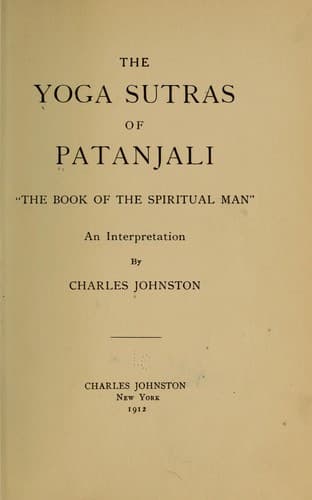
The Yoga Sutras of Patanjali: The Book of the Spiritual ManPatañjali
Religion
The Yoga Sutras of Patanjali: The Book of the Spiritual Man
Patañjali
Yoga -- Early works to 1800
44. The same two steps, when referring to things of finer substance,
are said to be with, or without, judicial action of the mind.
We now come to mental or psychical objects: to images in the mind. It
is precisely by comparing, arranging and superposing these mind-images
that we get our general notions or concepts. This process of analysis
and synthesis, whereby we select certain qualities in a group of
mind-images, and then range together those of like quality, is the
judicial action of the mind spoken of. But when we exercise swift
divination upon the mind images, as does a poet or a man of genius,
then we use a power higher than the judicial, and one nearer to the
keen vision of the spiritual man.
45. Subtle substance rises in ascending degrees, to that pure nature
which has no distinguishing mark.
As we ascend from outer material things which are permeated by
separateness, and whose chief characteristic is to be separate, just as
so many pebbles are separate from each other; as we ascend, first, to
mind-images, which overlap and coalesce in both space and time, and
then to ideas and principles, we finally come to purer essences,
drawing ever nearer and nearer to unity.
Or we may illustrate this principle thus. Our bodily, external selves
are quite distinct and separate, in form, name, place, substance; our
mental selves, of finer substance, meet and part, meet and part again,
in perpetual concussion and interchange; our spiritual selves attain
true consciousness through unity, where the partition wall between us
and the Highest, between us and others, is broken down and we are all
made perfect in the One. The highest riches are possessed by all pure
souls, only when united. Thus we rise from separation to true
individuality in unity.
46. The above are the degrees of limited and conditioned spiritual
consciousness, still containing the seed of separateness.
In the four stages of perception above described, the spiritual vision
is still working through the mental and psychical, the inner genius is
still expressed through the outer, personal man. The spiritual man has
yet to come completely to consciousness as himself, in his own realm,
the psychical veils laid aside.
47. When pure perception without judicial action of the mind is
reached, there follows the gracious peace of the inner self.
We have instanced certain types of this pure perception: the poet’s
divination, whereby he sees the spirit within the symbol, likeness in
things unlike, and beauty in all things; the pure insight of the true
philosopher, whose vision rests not on the appearances of life, but on
its realities; or the saint’s firm perception of spiritual life and
being. All these are far advanced on the way; they have drawn near to
the secret dwelling of peace.
48. In that peace, perception is unfailingly true.
Public-domain text, read in full here on John Shaqi.
Reviews
Reviews
No reviews yet
Be the first to share your thoughts on this work.
Join the Discussion
Join the discussion
Sign in to leave a comment or review.
Sign InorCreate an account