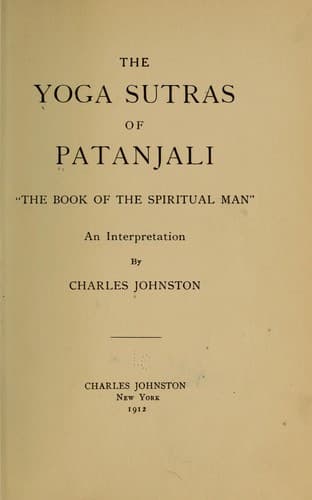
The Yoga Sutras of Patanjali: The Book of the Spiritual Man — John Shaqi
The Yoga Sutras of Patanjali: The Book of the Spiritual ManPatañjali
Religion
The Yoga Sutras of Patanjali: The Book of the Spiritual Man
Patañjali
Yoga -- Early works to 1800
Spiritual reading meant, for ancient India, something more than it does
with us. It meant, first, the recital of sacred texts, which, in their
very sounds, had mystical potencies; and it meant a recital of texts
which were divinely emanated, and held in themselves the living, potent
essence of the divine.
For us, spiritual reading means a communing with the recorded teachings
of the Masters of wisdom, whereby we read ourselves into the Master’s
mind, just as through his music one can enter into the mind and soul of
the master musician. It has been well said that all true art is
contagion of feeling; so that through the true reading of true books we
do indeed read ourselves into the spirit of the Masters, share in the
atmosphere of their wisdom and power, and come at last into their very
presence.
45. Soul-vision is perfected through perfect obedience to the Master.
The sorrow and darkness of life come of the erring personal will which
sets itself against the will of the Soul, the one great Life. The error
of the personal will is inevitable, since each will must be free to
choose, to try and fail, and so to find the path. And sorrow and
darkness are inevitable, until the path be found, and the personal will
made once more one with the greater Will, wherein it finds rest and
power, without losing freedom. In His will is our peace. And with that
peace comes light. Soul-vision is perfected through obedience.
46. Right poise must be firm and without strain.
Here we approach a section of the teaching which has manifestly a
two-fold meaning. The first is physical, and concerns the bodily
position of the student, and the regulation of breathing. These things
have their direct influence upon soul-life, the life of the spiritual
man, since it is always and everywhere true that our study demands a
sound mind in a sound body. The present sentence declares that, for
work and for meditation, the position of the body must be steady and
without strain, in order that the finer currents of life may run their
course.
It applies further to the poise of the soul, that fine balance and
stability which nothing can shake, where the consciousness rests on the
firm foundation of spiritual being. This is indeed the house set upon a
rock, which the winds and waves beat upon in vain.
47. Right poise is to be gained by steady and temperate effort, and by
setting the heart upon the everlasting.
Here again, there is the two-fold meaning, for physical poise is to be
gained by steady effort of the muscles, by gradual and wise training,
linked with a right understanding of, and relation with, the universal
force of gravity. Uprightness of body demands that both these
conditions shall be fulfilled.
Public-domain text, read in full here on John Shaqi.
Reviews
Reviews
No reviews yet
Be the first to share your thoughts on this work.
Join the Discussion
Join the discussion
Sign in to leave a comment or review.
Sign InorCreate an account