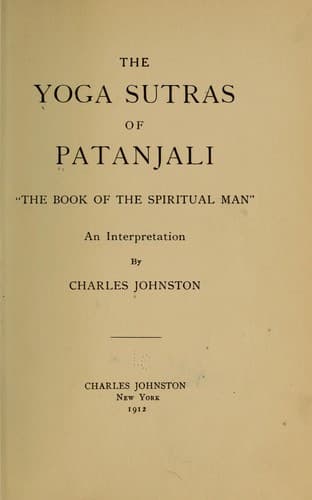
The Yoga Sutras of Patanjali: The Book of the Spiritual ManPatañjali
Religion
The Yoga Sutras of Patanjali: The Book of the Spiritual Man
Patañjali
Yoga -- Early works to 1800
The reason is this: The threefold power we have been considering, the
triad of Attention, Contemplation, Meditation is, so far as we have yet
considered it, the focussing of the beam of perceiving consciousness
upon some form of manifesting being, with a view of understanding it
completely. There is a higher stage, where the beam of consciousness is
turned back upon itself, and the individual consciousness enters into,
and knows, the All consciousness. This is a being, a being in
immortality, rather than a knowing; it is free from mental analysis or
mental forms. It is not an activity of the higher mind, even the mind
of the spiritual man. It is an activity of the soul. Had Newton risen
to this higher stage, he would have known, not the laws of motion, but
that high Being, from whose Life comes eternal motion. Had Darwin risen
to this, he would have seen the Soul, whose graduated thought and being
all evolution expresses. There are, therefore, these two perceptions:
that of living things, and that of the Life; that of the Soul’s works,
and that of the Soul itself.
9. One of the ascending degrees is the development of Control. First
there is the overcoming of the mind-impress of excitation. Then comes
the manifestation of the mind-impress of Control. Then the perceiving
consciousness follows after the moment of Control.
This is the development of Control. The meaning seems to be this: Some
object enters the field of observation, and at first violently excites
the mind, stirring up curiosity, fear, wonder; then the consciousness
returns upon itself, as it were, and takes the perception firmly in
hand, steadying itself, and viewing the matter calmly from above. This
steadying effort of the will upon the perceiving consciousness is
Control, and immediately upon it follows perception, understanding,
insight.
Take a trite example. Supposing one is walking in an Indian forest. A
charging elephant suddenly appears. The man is excited by astonishment,
and, perhaps, terror. But he exercises an effort of will, perceives the
situation in its true bearings, and recognizes that a certain thing
must be done; in this case, probably, that he must get out of the way
as quickly as possible.
Or a comet, unheralded, appears in the sky like a flaming sword. The
beholder is at first astonished, perhaps terror-stricken; but he takes
himself in hand, controls his thoughts, views the apparition calmly,
and finally calculates its orbit and its relation to meteor showers.
Public-domain text, read in full here on John Shaqi.
Reviews
Reviews
No reviews yet
Be the first to share your thoughts on this work.
Join the Discussion
Join the discussion
Sign in to leave a comment or review.
Sign InorCreate an account