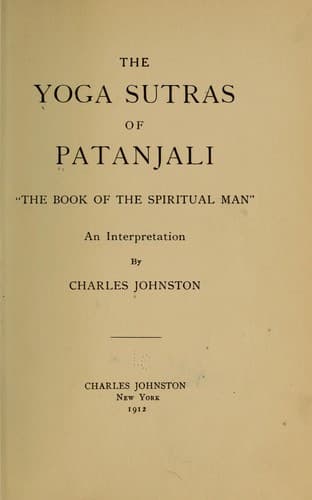
The Yoga Sutras of Patanjali: The Book of the Spiritual Man — John Shaqi
The Yoga Sutras of Patanjali: The Book of the Spiritual ManPatañjali
Religion
The Yoga Sutras of Patanjali: The Book of the Spiritual Man
Patañjali
Yoga -- Early works to 1800
These are extreme illustrations; but with all knowledge the order of
perception is the same: first, the excitation of the mind by the new
object impressed on it; then the control of the mind from within; upon
which follows the perception of the nature of the object. Where the
eyes of the spiritual man are open, this will be a true and penetrating
spiritual perception. In some such way do our living experiences come
to us; first, with a shock of pain; then the Soul steadies itself and
controls the pain; then the spirit perceives the lesson of the event,
and its bearing upon the progressive revelation of life.
10. Through frequent repetition of this process, the mind becomes
habituated to it, and there arises an equable flow of perceiving
consciousness.
Control of the mind by the Soul, like control of the muscles by the
mind, comes by practice, and constant voluntary repetition.
As an example of control of the muscles by the mind, take the ceaseless
practice by which a musician gains mastery over his instrument, or a
fencer gains skill with a rapier. Innumerable small efforts of
attention will make a result which seems well-nigh miraculous; which,
for the novice, is really miraculous. Then consider that far more
wonderful instrument, the perceiving mind, played on by that fine
musician, the Soul. Here again, innumerable small efforts of attention
will accumulate into mastery, and a mastery worth winning. For a
concrete example, take the gradual conquest of each day, the effort to
live that day for the Soul. To him that is faithful unto death, the
Master gives the crown of life.
11. The gradual conquest of the mind’s tendency to flit from one object
to another, and the power of one-pointedness, make the development of
Contemplation.
As an illustration of the mind’s tendency to flit from one object to
another, take a small boy, learning arithmetic. He begins: two ones are
two; three ones are three-and then he thinks of three coins in his
pocket, which will purchase so much candy, in the store down the
street, next to the toy-shop, where are base-balls, marbles and so
on,—and then he comes back with a jerk, to four ones are four. So with
us also. We are seeking the meaning of our task, but the mind takes
advantage of a moment of slackened attention, and flits off from one
frivolous detail to another, till we suddenly come back to
consciousness after traversing leagues of space. We must learn to
conquer this, and to go back within ourselves into the beam of
perceiving consciousness itself, which is a beam of the Oversoul. This
is the true onepointedness, the bringing of our consciousness to a
focus in the Soul.
12. When, following this, the controlled manifold tendency and the
aroused one-pointedness are equally balanced parts of the perceiving
consciousness, his the development of one-pointedness.
Public-domain text, read in full here on John Shaqi.
Reviews
Reviews
No reviews yet
Be the first to share your thoughts on this work.
Join the Discussion
Join the discussion
Sign in to leave a comment or review.
Sign InorCreate an account