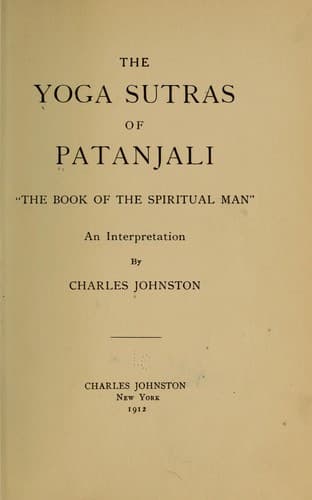
The Yoga Sutras of Patanjali: The Book of the Spiritual ManPatañjali
Religion
The Yoga Sutras of Patanjali: The Book of the Spiritual Man
Patañjali
Yoga -- Early works to 1800
This would seem to mean that the insight which is called
one-pointedness has two sides, equally balanced. There is, first, the
manifold aspect of any object, the sum of all its characteristics and
properties. This is to be held firmly in the mind. Then there is the
perception of the object as a unity, as a whole, the perception of its
essence. First, the details must be clearly perceived; then the essence
must be comprehended. When the two processes are equally balanced, the
true onepointedness is attained. Everything has these two sides, the
side of difference and the side of unity; there is the individual and
there is the genus; the pole of matter and diversity, and the pole of
oneness and spirit. To see the object truly, we must see both.
13. Through this, the inherent character, distinctive marks and
conditions of being and powers, according to their development, are
made clear.
By the power defined in the preceding sutra, the inherent character,
distinctive marks and conditions of beings and powers are made clear.
For through this power, as defined, we get a twofold view of each
object, seeing at once all its individual characteristics and its
essential character, species and genus; we see it in relation to
itself, and in relation to the Eternal. Thus we see a rose as that
particular flower, with its colour and scent, its peculiar fold of each
petal; but we also see in it the species, the family to which it
belongs, with its relation to all plants, to all life, to Life itself.
So in any day, we see events and circumstances; we also see in it the
lesson set for the soul by the Eternal.
14. Every object has its characteristics which are already quiescent,
those which are active, and those which are not yet definable.
Every object has characteristics belonging to its past, its present and
its future. In a fir tree, for example, there are the stumps or scars
of dead branches, which once represented its foremost growth; there are
the branches with their needles spread out to the air; there are the
buds at the end of each branch and twig, which carry the still closely
packed needles which are the promise of the future. In like manner, the
chrysalis has, as its past, the caterpillar; as its future, the
butterfly. The man has, in his past, the animal; in his future, the
angel. Both are visible even now in his face. So with all things, for
all things change and grow.
15. Difference in stage is the cause of difference in development.
This but amplifies what has just been said. The first stage is the
sapling, the caterpillar, the animal. The second stage is the growing
tree, the chrysalis, the man. The third is the splendid pine, the
butterfly, the angel. Difference of stage is the cause of difference of
development. So it is among men, and among the races of men.
16. Through perfectly concentrated Meditation on the three stages of
development comes a knowledge of past and future.
Public-domain text, read in full here on John Shaqi.
Reviews
Reviews
No reviews yet
Be the first to share your thoughts on this work.
Join the Discussion
Join the discussion
Sign in to leave a comment or review.
Sign InorCreate an account