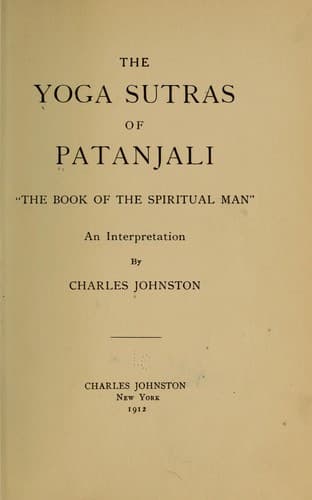
The Yoga Sutras of Patanjali: The Book of the Spiritual ManPatañjali
Religion
The Yoga Sutras of Patanjali: The Book of the Spiritual Man
Patañjali
Yoga -- Early works to 1800
The spiritual man is enmeshed in the web of the emotions; desire, fear,
ambition, passion; and impeded by the mental forms of separateness and
materialism. When these meshes are sundered, these obstacles completely
overcome, then the spiritual man stands forth in his own wide world,
strong, mighty, wise. He uses divine powers, with a divine scope and
energy, working together with divine Companions. To such a one it is
said: “Thou art now a disciple, able to stand, able to hear, able to
see, able to speak, thou hast conquered desire and attained to
self-knowledge, thou hast seen thy soul in its bloom and recognized it,
and heard the voice of the silence.”
50. By absence of all self-indulgence at this point, when the seeds of
bondage to sorrow are destroyed, pure spiritual being is attained.
The seeking of indulgence for the personal self, whether through
passion or ambition, sows the seed of future sorrow. For this self
indulgence of the personality is a double sin against the real; a sin
against the cleanness of life, and a sin against the universal being,
which permits no exclusive particular good, since, in the real, all
spiritual possessions are held in common. This twofold sin brings its
reacting punishment, its confining bondage to sorrow. But ceasing from
self-indulgence brings purity, liberation, spiritual life.
51. There should be complete overcoming of allurement or pride in the
invitations of the different realms of life, lest attachment to things
evil arise once more.
The commentator tells us that disciples, seekers for union, are of four
degrees: first, those who are entering the path; second, those who are
in the realm of allurements; third, those who have won the victory over
matter and the senses; fourth, those who stand firm in pure spiritual
life. To the second, especially, the caution in the text is addressed.
More modern teachers would express the same truth by a warning against
the delusions and fascinations of the psychic realm, which open around
the disciple, as he breaks through into the unseen worlds. These are
the dangers of the anteroom. Safety lies in passing on swiftly into the
inner chamber. “Him that overcometh will I make a pillar in the temple
of my God, and he shall go no more out.”
52. From perfectly concentrated Meditation on the divisions of time and
their succession comes that wisdom which is born of discernment.
The Upanishads say of the liberated that “he has passed beyond the
triad of time”; he no longer sees life as projected into past, present
and future, since these are forms of the mind; but beholds all things
spread out in the quiet light of the Eternal. This would seem to be the
same thought, and to point to that clear-eyed spiritual perception
which is above time; that wisdom born of the unveiling of Time’s
delusion. Then shall the disciple live neither in the present nor the
future, but in the Eternal.
Public-domain text, read in full here on John Shaqi.
Reviews
Reviews
No reviews yet
Be the first to share your thoughts on this work.
Join the Discussion
Join the discussion
Sign in to leave a comment or review.
Sign InorCreate an account