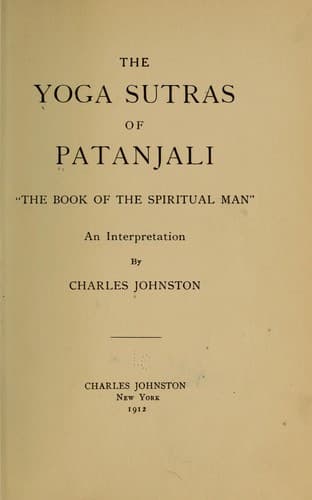
The Yoga Sutras of Patanjali: The Book of the Spiritual Man — John Shaqi
The Yoga Sutras of Patanjali: The Book of the Spiritual ManPatañjali
Religion
The Yoga Sutras of Patanjali: The Book of the Spiritual Man
Patañjali
Yoga -- Early works to 1800
Having shown that our bodily condition and circumstances depend on
Karma, while Karma depends on perception and will, the sage recognizes
the fact that from this may be drawn the false deduction that material
things are in no wise different from states of mind. The same thought
has occurred, and still occurs, to all philosophers; and, by various
reasonings, they all come to the same wise conclusion; that the
material world is not made by the mood of any human mind, but is rather
the manifestation of the totality of invisible Being, whether we call
this Mahat, with the ancients, or Ether, with the moderns.
16. Nor do material objects depend upon a single mind, for how could
they remain objective to others, if that mind ceased to think of them?
This is but a further development of the thought of the preceding
Sutra, carrying on the thought that, while the universe is spiritual,
yet its material expression is ordered, consistent, ruled by law, not
subject to the whims or affirmations of a single mind. Unwelcome
material things may be escaped by spiritual growth, by rising to a
realm above them, and not by denying their existence on their own
plane. So that our system is neither materialistic, nor idealistic in
the extreme sense, but rather intuitional and spiritual, holding that
matter is the manifestation of spirit as a whole, a reflection or
externalization of spirit, and, like spirit, everywhere obedient to
law. The path of liberation is not through denial of matter but through
denial of the wills of self, through obedience, and that aspiration
which builds the vesture of the spiritual man.
17. An object is perceived, or not perceived, according as the mind is,
or is not, tinged with the colour of the object.
The simplest manifestation of this is the matter of attention. Our
minds apprehend what they wish to apprehend; all else passes unnoticed,
or, on the other hand, we perceive what we resent, as, for example, the
noise of a passing train; while others, used to the sound, do not
notice it at all.
But the deeper meaning is, that out of the vast totality of objects
ever present in the universe, the mind perceives only those which
conform to the hue of its Karma. The rest remain unseen, even though
close at hand.
This spiritual law has been well expressed by Emerson:
Public-domain text, read in full here on John Shaqi.
Reviews
Reviews
No reviews yet
Be the first to share your thoughts on this work.
Join the Discussion
Join the discussion
Sign in to leave a comment or review.
Sign InorCreate an account