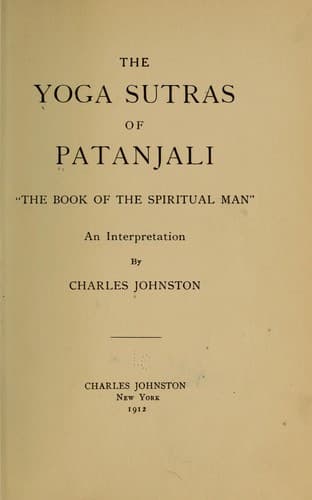
The Yoga Sutras of Patanjali: The Book of the Spiritual Man — John Shaqi
The Yoga Sutras of Patanjali: The Book of the Spiritual ManPatañjali
Religion
The Yoga Sutras of Patanjali: The Book of the Spiritual Man
Patañjali
Yoga -- Early works to 1800
“Through solidest eternal things the man finds his road as if they did
not subsist, and does not once suspect their being. As soon as he needs
a new object, suddenly he beholds it, and no longer attempts to pass
through it, but takes another way. When he has exhausted for the time
the nourishment to be drawn from any one person or thing, that object
is withdrawn from his observation, and though still in his immediate
neighbourhood, he does not suspect its presence. Nothing is dead. Men
feign themselves dead, and endure mock funerals and mournful
obituaries, and there they stand looking out of the window, sound and
well, in some new and strange disguise. Jesus is not dead, he is very
well alive: nor John, nor Paul, nor Mahomet, nor Aristotle; at times we
believe we have seen them all, and could easily tell the names under
which they go.”
18. The movements of the psychic nature are perpetually objects of
perception, since the Spiritual Man, who is the lord of them, remains
unchanging.
Here is teaching of the utmost import, both for understanding and for
practice.
To the psychic nature belong all the ebb and flow of emotion, all
hoping and fearing, desire and hate: the things that make the multitude
of men and women deem themselves happy or miserable. To it also belong
the measuring and comparing, the doubt and questioning, which, for the
same multitude, make up mental life. So that there results the
emotion-soaked personality, with its dark and narrow view of life: the
shivering, terror driven personality that is life itself for all but
all of mankind.
Yet the personality is not the true man, not the living soul at all,
but only a spectacle which the true man observes. Let us under stand
this, therefore, and draw ourselves up inwardly to the height of the
Spiritual Man, who, standing in the quiet light of the Eternal, looks
down serene upon this turmoil of the outer life.
One first masters the personality, the “mind,” by thus looking down on
it from above, from within; by steadily watching its ebb and flow, as
objective, outward, and therefore not the real Self. This standing back
is the first step, detachment. The second, to maintain the
vantage-ground thus gained, is recollection.
19. The Mind is not self-luminous, since it can be seen as an object.
This is a further step toward overthrowing the tyranny of the “mind”:
the psychic nature of emotion and mental measuring. This psychic self,
the personality, claims to be absolute, asserting that life is for it
and through it; it seeks to impose on the whole being of man its
narrow, materialistic, faithless view of life and the universe; it
would clip the wings of the soaring Soul. But the Soul dethrones the
tyrant, by perceiving and steadily affirming that the psychic self is
no true self at all, not self-luminous, but only an object of
observation, watched by the serene eyes of the Spiritual Man.
20. Nor could the Mind at the same time know itself and things external
to it.
Public-domain text, read in full here on John Shaqi.
Reviews
Reviews
No reviews yet
Be the first to share your thoughts on this work.
Join the Discussion
Join the discussion
Sign in to leave a comment or review.
Sign InorCreate an account