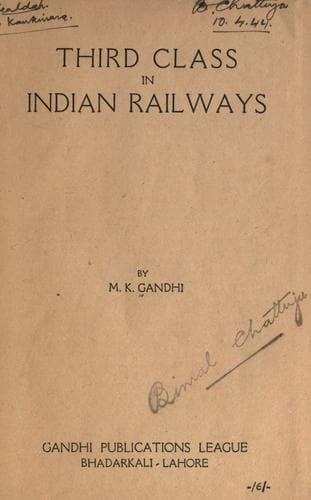
India -- History -- British occupation, 1765-1947; Pamphlets
What I have described is not exceptional but normal. I have got down at
Raichur, Dhond, Sonepur, Chakradharpur, Purulia, Asansol and other
junction stations and been at the 'Mosafirkhanas' attached to these
stations. They are discreditable-looking places where there is no
order, no cleanliness but utter confusion and horrible din and noise.
Passengers have no benches or not enough to sit on. They squat on dirty
floors and eat dirty food. They are permitted to throw the leavings of
their food and spit where they like, sit how they like and smoke
everywhere. The closets attached to these places defy description. I
have not the power adequately to describe them without committing a
breach of the laws of decent speech. Disinfecting powder, ashes, or
disinfecting fluids are unknown. The army of flies buzzing about them
warns you against their use. But a third-class traveller is dumb and
helpless. He does not want to complain even though to go to these places
may be to court death. I know passengers who fast while they are
travelling just in order to lessen the misery of their life in the
trains. At Sonepur flies having failed, wasps have come forth to warn
the public and the authorities, but yet to no purpose. At the Imperial
Capital a certain third class booking-office is a Black-Hole fit only to
be destroyed.
Is it any wonder that plague has become endemic in India? Any other
result is impossible where passengers always leave some dirt where they
go and take more on leaving.
On Indian trains alone passengers smoke with impunity in all carriages
irrespective of the presence of the fair sex and irrespective of the
protest of non-smokers. And this, notwithstanding a bye-law which
prevents a passenger from smoking without the permission of his fellows
in the compartment which is not allotted to smokers.
The existence of the awful war cannot be allowed to stand in the way of
the removal of this gigantic evil. War can be no warrant for tolerating
dirt and overcrowding. One could understand an entire stoppage of
passenger traffic in a crisis like this, but never a continuation or
accentuation of insanitation and conditions that must undermine health
and morality.
Compare the lot of the first class passengers with that of the third
class. In the Madras case the first class fare is over five times as
much as the third class fare. Does the third class passenger get
one-fifth, even one-tenth, of the comforts of his first class fellow? It
is but simple justice to claim that some relative proportion be observed
between the cost and comfort.
It is a known fact that the third class traffic pays for the
ever-increasing luxuries of first and second class travelling. Surely a
third class passenger is entitled at least to the bare necessities of
life.
Public-domain text, read in full here on John Shaqi.
Reviews
Reviews
No reviews yet
Be the first to share your thoughts on this work.
Join the Discussion
Join the discussion
Sign in to leave a comment or review.
Sign InorCreate an account