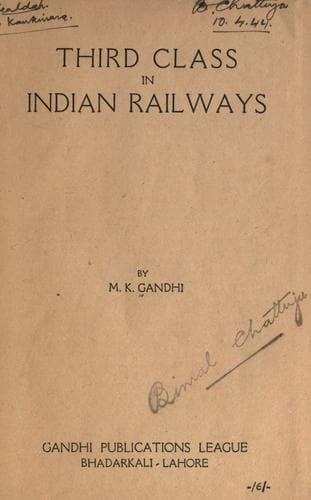
India -- History -- British occupation, 1765-1947; Pamphlets
In neglecting the third class passengers, opportunity of giving a
splendid education to millions in orderliness, sanitation, decent
composite life and cultivation of simple and clean tastes is being lost.
Instead of receiving an object lesson in these matters third class
passengers have their sense of decency and cleanliness blunted during
their travelling experience.
Among the many suggestions that can be made for dealing with the evil
here described, I would respectfully include this: let the people in
high places, the Viceroy, the Commander-in-Chief, the Rajas, Maharajas,
the Imperial Councillors and others, who generally travel in superior
classes, without previous warning, go through the experiences now and
then of third class travelling. We would then soon see a remarkable
change in the conditions of third class travelling and the uncomplaining
millions will get some return for the fares they pay under the
expectation of being carried from place to place with ordinary creature
comforts.
FOOTNOTE:
[1] Ranchi, September 25, 1917.
VERNACULARS AS MEDIA OF INSTRUCTION[2]
It is to be hoped that Dr. Mehta's labour of love will receive the
serious attention of English-educated India. The following pages were
written by him for the _Vedanta Kesari_ of Madras and are now printed in
their present form for circulation throughout India. The question of
vernaculars as media of instruction is of national importance; neglect
of the vernaculars means national suicide. One hears many protagonists
of the English language being continued as the medium of instruction
pointing to the fact that English-educated Indians are the sole
custodians of public and patriotic work. It would be monstrous if it
were not so. For the only education given in this country is through the
English language. The fact, however, is that the results are not all
proportionate to the time we give to our education. We have not reacted
on the masses. But I must not anticipate Dr. Mehta. He is in earnest. He
writes feelingly. He has examined the pros and cons and collected a mass
of evidence in support of his arguments. The latest pronouncement on the
subject is that of the Viceroy. Whilst His Excellency is unable to offer
a solution, he is keenly alive to the necessity of imparting instruction
in our schools through the vernaculars. The Jews of Middle and Eastern
Europe, who are scattered in all parts of the world, finding it
necessary to have a common tongue for mutual intercourse, have raised
Yiddish to the status of a language, and have succeeded in translating
into Yiddish the best books to be found in the world's literature. Even
they could not satisfy the soul's yearning through the many foreign
tongues of which they are masters; nor did the learned few among them
wish to tax the masses of the Jewish population with having to learn a
foreign language before they could realise their dignity. So they have
Public-domain text, read in full here on John Shaqi.
Reviews
Reviews
No reviews yet
Be the first to share your thoughts on this work.
Join the Discussion
Join the discussion
Sign in to leave a comment or review.
Sign InorCreate an account