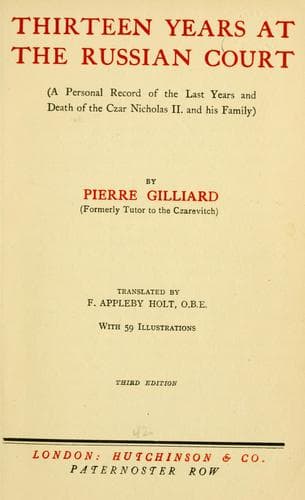
Thirteen years at the Russian court: (a personal record of the last years and death of the Czar Nicholas II. and his family)Gilliard, Pierre
History
Thirteen years at the Russian court: (a personal record of the last years and death of the Czar Nicholas II. and his family)
Gilliard, Pierre
Nicholas II, Emperor of Russia, 1868-1918; Romanov, House of; Soviet Union -- History -- Revolution, 1917-1921 -- Personal narratives
“Her education, bringing-up, her intellectual and moral outlook were
entirely English. She was English in appearance and bearing, in a
certain element of reserve and Puritanism, in the intractable and
militant austerity of her conscience, and, lastly, in many of her
personal habits. In any case, that was all that was left of her Western
origin. The basis of her character had become entirely Russian. In
spite of the hostile legend which was growing up round her name, I did
not doubt her patriotism. She had a fervent love of Russia.”
[44] It was only subsequently that I learned that, to overcome the
resistance he met with at Bucharest, the Minister for Foreign Affairs,
Sturmer (who had succeeded Sazonoff), had promised that Russian troops
would be sent to Rumania. He had not referred to G.H.Q. first.
[45] History will one day settle what part Sturmer played. If he did
not actually work for a _rapprochement_ with Germany, though everything
seems to show that he did, he none the less did his country irreparable
harm through his criminal negligence and utter lack of scruples.
[46] The very education of a sovereign makes him entirely unfitted
for the task before him, and yet it is impossible to make good the
defect afterwards. The larger the part he plays in government the less
he knows of what is going on. To keep him away from his people he is
given nothing but mutilated, distorted, and “cooked” reports. No one
can realise the resisting power of those about a throne, the invincible
apathy of a bureaucracy steeped in traditional observance and routine!
Whatever strength of mind, whatever tenacity a sovereign may display in
finding out the truth, does he ever really succeed? Napoleon had been
through the school of life, and raised himself to a throne by sheer
genius and audacity, but his fate was the same as that of other rulers.
In the last years of his reign did he still know what was happening in
France? Had he still a sense of reality?
[47] It really seems that a perverse fate intervened to protect
Rasputin. One day the Czar was given a document in which the excesses
of the _staretz_ were set forth highly circumstantially. In reading it
the Czar observed that on the day and hour at which one of the acts
mentioned in the document were alleged to have taken place Rasputin had
actually been at Tsarskoïe-Selo. Nothing more was required to convince
the Czar that the whole report was simply a tissue of lies.
[48] The Grand-Duchess Elizabeth Feodorovna had founded a small
religious community, of which she was the Superior, at Moscow. She
lived there retired from the world, devoting all her time to prayer and
good works.
[49] I had all these details from the lips of Mlle. Schneider, reader
to the Czarina, who had once been in the household of the Grand-Duchess
Elizabeth, who had always remained very fond of her.
Public-domain text, read in full here on John Shaqi.
Reviews
Reviews
No reviews yet
Be the first to share your thoughts on this work.
Elsewhere in the archive
Join the Discussion
Join the discussion
Sign in to leave a comment or review.
Sign InorCreate an account