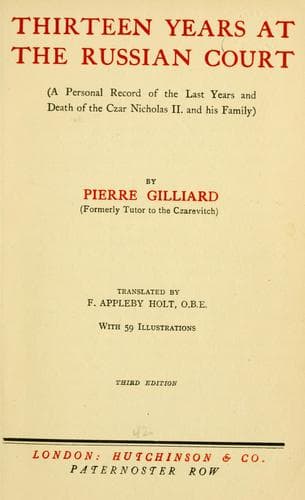
Thirteen years at the Russian court: (a personal record of the last years and death of the Czar Nicholas II. and his family)Gilliard, Pierre
History
Thirteen years at the Russian court: (a personal record of the last years and death of the Czar Nicholas II. and his family)
Gilliard, Pierre
Nicholas II, Emperor of Russia, 1868-1918; Romanov, House of; Soviet Union -- History -- Revolution, 1917-1921 -- Personal narratives
[50] The circumstances of Rasputin’s death are to be found in the
newspapers of the time. I will briefly recapitulate them here. His
death was the result of a plot in which some of the participants were
the Grand-Duke Dimitri Pavlovitch, first cousin of the Czar, Prince
Yussoupoff, whose wife was the niece of Nicholas II., M. Purichkevitch,
a monarchist deputy in the Duma, and Dr. Lazarevsky, who accompanied
him. The Grand-Duke wished to show by his presence that it was not a
case of an act of rebellion against the Czar, but merely the execution
of a miscreant whom the nation had judged and found guilty of abusing
the confidence of his sovereign.
Rasputin was killed on the night of December 30th. Prince Yussoupoff
had gone to fetch him in his car very late in the evening, and brought
him to his house. They first tried to poison him, but as the poison was
slow in taking effect, Prince Yussoupoff and the deputy killed him with
revolvers. His corpse was thrown into the Neva and was picked up two
days later.
[51] I am referring, of course, to the articulate portion of the
nation. The untutored masses cared nothing about him, and among those
who knew of his existence a large number were favourable to him. Many
considered his death an act of vengeance on the part of the courtiers
who were jealous of their privileges. “The first time that one of
ourselves gets to the Czar, he is killed by the courtiers,” they said.
To the _moujik_ the great criminals were those who came between the
sovereign and his people, and prevented him from extending his favours
to them. There was a popular saying that “the Czar gives, but his
servants withhold,” in which the peasant expressed his faith in the
goodness of his Czar and his hatred of those around him.
[52] Ludendorff, _My War Memories_, vol. ii. (Hutchinson and Co.,
London). What Ludendorff did not mention, and for good reason, was the
untiring efforts Germany had made to produce this revolution which had
broken out so unexpectedly.
[53] Is not this idea illustrated in the popular saying which betrays
the simple faith of the Russian peasant and his feeling of impotence:
“God is a very long way up; the Czar a very long way off.”
[54] Ludendorff exaggerates the _rôle_ of the Entente in the Russian
Revolution when he writes: “In March, 1917, a Revolution, the work of
the Entente, overthrew the Czar.” The movement was supported by the
Allies, but it was not their work. Ludendorff shows well enough what
were its immediate results for Germany. “The Revolution meant a fatal
loss of military power to Russia, weakened the Entente and gave us
considerable relief in our heavy task. The General Staff could at once
effect important economies of troops and ammunition, and could also
exchange divisions on a much greater scale.” And further on: “In April
and May, 1917, it was the Russian Revolution which saved us in spite
of our victory on the Aisne and in Champagne.” (Ludendorff, _My War
Memories_, vol. ii.).
Public-domain text, read in full here on John Shaqi.
Reviews
Reviews
No reviews yet
Be the first to share your thoughts on this work.
Elsewhere in the archive
Join the Discussion
Join the discussion
Sign in to leave a comment or review.
Sign InorCreate an account