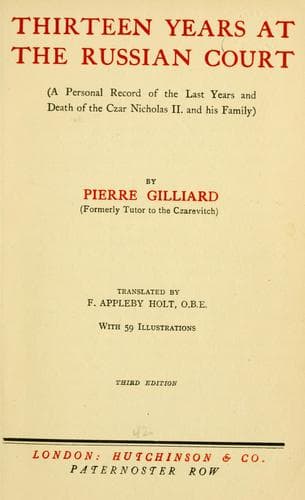
Thirteen years at the Russian court: (a personal record of the last years and death of the Czar Nicholas II. and his family)Gilliard, Pierre
History
Thirteen years at the Russian court: (a personal record of the last years and death of the Czar Nicholas II. and his family)
Gilliard, Pierre
Nicholas II, Emperor of Russia, 1868-1918; Romanov, House of; Soviet Union -- History -- Revolution, 1917-1921 -- Personal narratives
When the Czar and Czarina went to Hodinskoïe meadows next morning they
had heard nothing whatever of the terrible catastrophe. They were not
told the truth until they returned to the city subsequently, and they
never knew the whole truth. Did not those concerned realise that by
acting thus they were depriving the Imperial couple of a chance to show
their grief and sympathy and making their behaviour odious because it
seemed sheer indifference to public misfortune?
Several years of domestic bliss followed, and Fate seemed to have
loosened its grip.
Yet the task of the young Czarina was no easy one. She had to learn all
that it meant to be an empress, and that at the most etiquette ridden
Court in Europe and the scene of the worst forms of intrigue and
coterie. Accustomed to the simple life of Darmstadt, and having
experienced at the strict and formal English Court only such restraint
as affected a young and popular princess who was there merely on a
visit, she must have felt at sea with her new obligations and dazzled by
an existence of which all the proportions had suddenly changed. Her
sense of duty and her burning desire to devote herself to the welfare of
the millions whose Czarina she had become fired her ambitions, but at
the same time checked her natural impulses.
Yet her only thought was to win the hearts of her subjects.
Unfortunately she did not know how to show it, and the innate timidity
from which she suffered was wont to play the traitor to her kind
intentions. She very soon realised how impotent she was to gain sympathy
and understanding. Her frank and spontaneous nature was speedily
repelled by the icy conventions of her environment. Her impulses came
up against the prevalent inertia about her,[9] and when in return for
her confidence she asked for intelligent devotion and real good will,
those with whom she dealt took refuge in the easy zeal of the polite
formalities of Courts.
In spite of all her efforts, she never succeeded in being merely amiable
and acquiring the art which consists of flitting gracefully but
superficially over all manner of subjects. The fact is that the Czarina
was nothing if not sincere. Every word from her lips was the true
expression of her real feelings. Finding herself misunderstood, she
quickly drew back into her shell. Her natural pride was wounded. She
appeared less and less at the ceremonies and receptions she regarded as
an intolerable nuisance. She adopted a habit of distant reserve which
was taken for haughtiness and contempt. But those who came in contact
with her in moments of distress knew what a sensitive spirit, what a
longing for affection, was concealed behind that apparent coldness. She
had accepted her new religion with entire sincerity, and found it a
great source of comfort in hours of trouble and anguish; but above all,
it was the affection of her family which nourished her love, and she was
never really happy except when she was with them.
Public-domain text, read in full here on John Shaqi.
Reviews
Reviews
No reviews yet
Be the first to share your thoughts on this work.
Join the Discussion
Join the discussion
Sign in to leave a comment or review.
Sign InorCreate an account