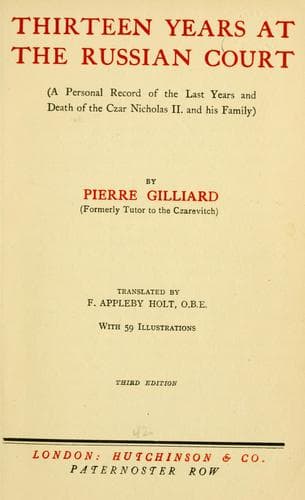
Thirteen years at the Russian court: (a personal record of the last years and death of the Czar Nicholas II. and his family)Gilliard, Pierre
History
Thirteen years at the Russian court: (a personal record of the last years and death of the Czar Nicholas II. and his family)
Gilliard, Pierre
Nicholas II, Emperor of Russia, 1868-1918; Romanov, House of; Soviet Union -- History -- Revolution, 1917-1921 -- Personal narratives
* * * * *
The birth of Olga Nicolaïevna had been followed by that of three other
fine and healthy daughters who were their parents’ delight. It was not
an unmixed delight, however, for the secret desire of their hearts--to
have a son and heir--had not yet been fulfilled. The birth of Anastasie
Nicolaïevna, the last of the Grand-Duchesses, had at first been a
terrible disappointment ... and the years were slipping by. At last, on
August 12th, 1904, when the Russo-Japanese War was at its height, the
Czarina gave birth to the son they so ardently desired. Their joy knew
no bounds. It seemed as if all the sorrows of the past were forgotten
and that an era of happiness was about to open for them.
Alas! it was but a short respite, and was followed by worse misfortunes:
first the January massacre in front of the Winter Palace--the memory of
which was to haunt them like a horrible nightmare for the rest of their
days--and then the lamentable conclusion of the Russo-Japanese War. In
those dark days their only consolation was their beloved son, and it had
not taken long, alas! to discover that the Czarevitch had hæmophilia.
From that moment the mother’s life was simply one dreadful agony. She
had already made the acquaintance of that terrible disease; she knew
that an uncle, one of her brothers, and two of her nephews had died of
it. From her childhood she had heard it spoken of as a dreadful and
mysterious thing against which men were powerless. And now her only son,
the child she loved more than anything else on earth, was affected!
Death would watch him, follow him at every step, and carry him off one
day like so many boys in his family. She must fight! She must save him
at any cost! It was impossible for science to be impotent. The means of
saving must exist, and they must be found. Doctors, surgeons,
specialists were consulted. But every kind of treatment was tried in
vain.
When the mother realised that no human aid could save, her last hope was
in God. He alone could perform the miracle. But she must be worthy of
His intervention. She was naturally of a pious nature, and she devoted
herself wholly to the Orthodox religion with the ardour and
determination she brought to everything. Life at Court became strict, if
not austere. Festivities were eschewed, and the number of occasions on
which the sovereigns had to appear in public was reduced to a minimum.
The family gradually became isolated from the Court and lived to itself,
so to speak.
Public-domain text, read in full here on John Shaqi.
Reviews
Reviews
No reviews yet
Be the first to share your thoughts on this work.
Join the Discussion
Join the discussion
Sign in to leave a comment or review.
Sign InorCreate an account