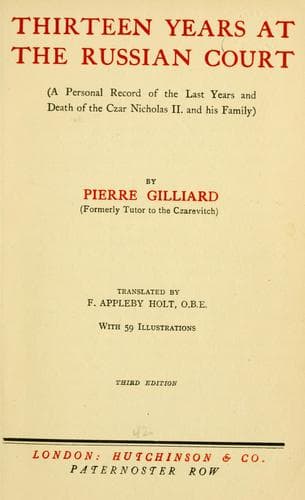
Thirteen years at the Russian court: (a personal record of the last years and death of the Czar Nicholas II. and his family)Gilliard, Pierre
History
Thirteen years at the Russian court: (a personal record of the last years and death of the Czar Nicholas II. and his family)
Gilliard, Pierre
Nicholas II, Emperor of Russia, 1868-1918; Romanov, House of; Soviet Union -- History -- Revolution, 1917-1921 -- Personal narratives
The absent Rasputin was more powerful than Rasputin in the flesh. His
psychic empire was based on an act of faith, for there is no limit to
the power of self-delusion possessed by those who mean to believe at all
cost. The history of mankind is there to prove it!
But how much suffering and what terrible disasters were to result from
the tragic aberration!
CHAPTER VI
LIFE AT TSARSKOÏE-SELO--MY PUPILS
(THE WINTER OF 1913-14)
To Rasputin was once more attributed the improvement in Alexis
Nicolaïevitch’s health a few days after the terrible attack to which I
have referred.
It will be remembered that the attack had occurred shortly after that
change in the Czarevitch’s manner of life I had thought it my duty to
advocate. I thus felt partially responsible.
I was in a very great difficulty. When I decided as I did, I had, of
course, realised the great dangers involved and thought myself strong
enough to face them. But the test of reality was so dreadful that I had
to consider whether I ought to persevere.... And yet I felt strongly
that I had no alternative.
After two months’ convalescence--the Czarevitch only recovered
slowly--the Czar and Czarina made up their minds to persevere with the
method they had adopted, notwithstanding the risks.
Dr. Botkin[12] and Dr. Derevenko were of a contrary opinion, but bowed
to the parents’ desires and bravely accepted a decision which added
considerably to the difficulties of a task which was exacting and
unpromising enough as it was. They were always on the look-out for the
possible crisis, and when the accident happened the struggle was all the
harder for them because they realised the inadequacy of the remedies at
their disposal. When, after nights of watching, they had the joy of
seeing their young patient out of dangerous, the improvement was
attributed, not to their care and efforts, but to the miraculous
intervention of Rasputin! But there was no false pride or envy about
them, for they were inspired by feelings of the deepest pity for the
tortured mother and father and the sufferings of the child who, at ten
years of age, had already had far more to bear than most men in a long
lifetime.
Our stay in the Crimea was longer than usual owing to Alexis
Nicolaïevitch’s illness, and we only returned to Tsarskoïe-Selo in
December. We then spent the whole winter of 1913-14 there.
Our life at Tsarskoïe-Selo was far more intimate than when we were in
residence at other palaces. With the exception of the maid-of-honour on
duty and the officer commanding the “composite”[13] regiment, the suite
did not live in the palace, and unless relations were visiting the
family the latter generally took their meals alone very quietly.
Public-domain text, read in full here on John Shaqi.
Reviews
Reviews
No reviews yet
Be the first to share your thoughts on this work.
Join the Discussion
Join the discussion
Sign in to leave a comment or review.
Sign InorCreate an account