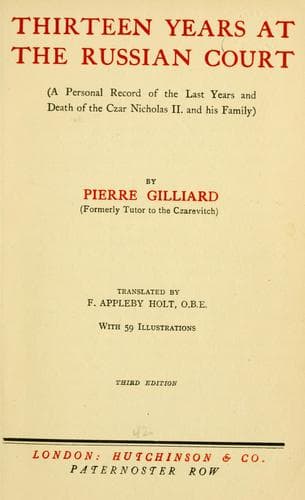
Thirteen years at the Russian court: (a personal record of the last years and death of the Czar Nicholas II. and his family)Gilliard, Pierre
History
Thirteen years at the Russian court: (a personal record of the last years and death of the Czar Nicholas II. and his family)
Gilliard, Pierre
Nicholas II, Emperor of Russia, 1868-1918; Romanov, House of; Soviet Union -- History -- Revolution, 1917-1921 -- Personal narratives
The fact was that Rasputin managed to make the two Bishops seem low
intriguers who had wanted to use him as an instrument, and then,
becoming jealous of a favour they could no longer exploit for their own
personal benefit, tried to bring about his downfall.
“The lowly Siberian peasant” had become a formidable adversary in whom
an utter lack of moral scruple was associated with consummate skill.
With a first-class intelligence service, and creatures of his own both
at Court and among the men around the ministers, as soon as he saw a new
enemy appear on the scene he was always careful to baulk him cleverly by
getting in the first blow.
Under the form of prophecies he would announce that he was going to be
the object of a new attack, taking good care not to indicate his
adversaries too plainly. So when the bolt was shot, the hand that
directed it held a crumbling missile. He often actually interceded in
favour of those who had attacked him, affirming with mock humility that
such trials were necessary for the good of his soul.
Another element which also contributed to keep alive the blind faith in
him which lasted until the end was the fact that the Czar and Czarina
were accustomed to see those to whom they paid particular attention
become objects of intrigue and cabals. They knew that their esteem alone
was sufficient to expose them to the attacks of the envious. The result
was that they were convinced that the special favour they showed to an
obscure _moujik_ was bound in any case to raise a storm of hate and
jealousy against him and make him the victim of the worst calumnies.
The scandal, however, gradually spread from the purely ecclesiastical
world. It was mentioned in whispers in political and diplomatic circles,
and was even referred to in speeches in the Duma.
In the spring of 1912, Count Kokovtzof, then President of the Council of
Ministers, decided to take the matter up with the Czar. The step was a
particularly delicate one, as hitherto Rasputin’s influence had been
confined to the Church and the Imperial family circle. Those were the
very spheres in which the Czar was most intolerant of any interference
by his ministers.
The Czar was not convinced by the Count’s action, but he realised that
some concession to public opinion was necessary. Shortly after Their
Majesties went to the Crimea, Rasputin left St. Petersburg and vanished
into Siberia.
Yet his influence was of the kind that distance does not diminish. On
the contrary, it only idealised him and increased his prestige.
As in his previous absences, there was a lively exchange of
telegrams--through the medium of Madame Wyroubova--between Pokrovskoïe
and the different residences occupied in turn by the Imperial family
during the year 1912.
Public-domain text, read in full here on John Shaqi.
Reviews
Reviews
No reviews yet
Be the first to share your thoughts on this work.
Join the Discussion
Join the discussion
Sign in to leave a comment or review.
Sign InorCreate an account