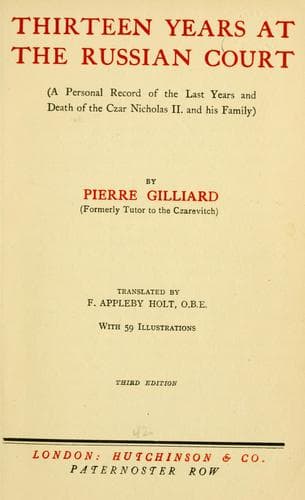
Thirteen years at the Russian court: (a personal record of the last years and death of the Czar Nicholas II. and his family)Gilliard, Pierre
History
Thirteen years at the Russian court: (a personal record of the last years and death of the Czar Nicholas II. and his family)
Gilliard, Pierre
Nicholas II, Emperor of Russia, 1868-1918; Romanov, House of; Soviet Union -- History -- Revolution, 1917-1921 -- Personal narratives
Marie Nicolaïevna was a fine girl, tall for her age, and a picture of
glowing health and colour. She had large and beautiful grey eyes. Her
tastes were very simple, and with her warm heart she was kindness
itself. Her sisters took advantage somewhat of her good nature, and
called her “fat little bow-wow.” She certainly had the benevolent and
somewhat _gauche_ devotion of a dog.
Anastasie Nicolaïevna, on the other hand, was very roguish and almost a
wag. She had a very strong sense of humour, and the darts of her wit
often found sensitive spots. She was rather an _enfant terrible_, though
this fault tended to correct itself with age. She was also extremely
idle, though with the idleness of a gifted child. Her French accent was
excellent, and she acted scenes from comedy with remarkable talent. She
was so lively, and her gaiety so infectious, that several members of the
suite had fallen into the way of calling her “Sunshine,” the nickname
her mother had been given at the English Court.
In short, the whole charm, difficult though it was to define, of these
four sisters was their extreme simplicity, candour, freshness, and
instinctive kindness of heart.
Their mother, whom they adored, was, so to speak, infallible in their
eyes. Olga Nicolaïevna alone showed occasional traces of independence.
They surrounded her with every attention. Of their own initiative they
had arranged matters in such a way that they could take turns of “duty”
with their mother, keeping her company for the day. When the Czarina was
ill the result was that the daughter on duty could not go out at all.
Their relations with the Czar were delightful. He was Emperor, father,
and friend in one.
Their feelings for him were thus dictated by circumstances, passing from
religious veneration to utter frankness and the warmest affection. Was
it not he before whom the ministers, the highest dignitaries of the
Church, the grand-dukes, and even their mother bowed in reverence, he
whose fatherly heart opened so willingly to their sorrows, he who joined
so merrily in their youthful amusements, far from the eyes of the
indiscreet?
With the exception of Olga Nicolaïevna, the Grand-Duchesses were very
moderate pupils. This was largely due to the fact that, in spite of my
repeated suggestions, the Czarina would never have a French governess.
No doubt she did not wish anyone to come between herself and her
daughters. The result was that though they read French, and liked it,
they were never able to speak it fluently.[15]
The Czarina’s state of health accounts for the fact that the education
of her daughters was to some extent neglected. The illness of Alexis
Nicolaïevitch had gradually worn down her powers of resistance. At times
of crisis she spared herself nothing and displayed remarkable energy and
courage. But, once the danger had passed, Nature resumed her rights, and
for weeks she would lie on a sofa quite exhausted by the strain.
Public-domain text, read in full here on John Shaqi.
Reviews
Reviews
No reviews yet
Be the first to share your thoughts on this work.
Join the Discussion
Join the discussion
Sign in to leave a comment or review.
Sign InorCreate an account