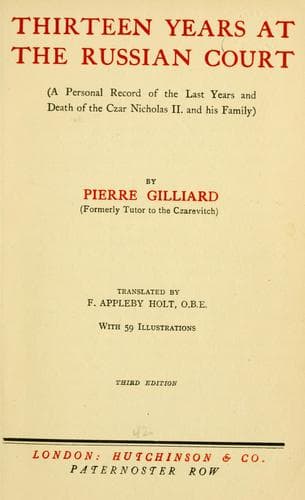
Thirteen years at the Russian court: (a personal record of the last years and death of the Czar Nicholas II. and his family)Gilliard, Pierre
History
Thirteen years at the Russian court: (a personal record of the last years and death of the Czar Nicholas II. and his family)
Gilliard, Pierre
Nicholas II, Emperor of Russia, 1868-1918; Romanov, House of; Soviet Union -- History -- Revolution, 1917-1921 -- Personal narratives
Olga Nicolaïevna did not fulfil the hopes I had set upon her. Her fine
intellect failed to find the elements necessary to its development.
Instead of making progress she began to go back. Her sisters had ever
had but little taste for learning, their gifts being of the practical
order.
By force of circumstances all four had soon learnt to be self-sufficient
and to find their natural good nature their sole resource. Very few
girls would have accommodated themselves so easily to a life such as
theirs--a life deprived of outside amusements, and with no other source
of distraction than those joys of family life which are so despised in
these days!
CHAPTER VII
THE INFLUENCE OF RASPUTIN--MADAME WYROUBOVA--MY TUTORIAL TROUBLES
(WINTER OF 1913)
While the illness of Alexis Nicolaïevitch threw such a gloom over the
Imperial family, and the influence of Rasputin, a product of their very
distress, continued to grow, life at Tsarskoïe-Selo seemed to flow along
as smoothly as ever, at any rate to outward appearance.
At that time I still knew very little about the _staretz_, and I was
searching everywhere for material on which to base my judgment, for his
personality interested me decidedly. But it was anything but easy. The
children never mentioned Rasputin’s name, and in my presence even
avoided the slightest allusion to his existence. I realised that in so
doing they were acting on their mother’s instructions. The Czarina no
doubt feared that as a foreigner and not orthodox I was incapable of
understanding the nature of the feelings of herself and her family
towards the _staretz_, feelings which made them revere him as a saint.
By imposing this duty of silence on my pupils she allowed me to ignore
Rasputin, or conveyed to me her desire that I should behave as if I knew
nothing about him. She thus deprived me of any chance of taking sides
against a man whose very name I realised I did not know.
From another source I had been able to convince myself that Rasputin
played a very insignificant part in the life of the Czarevitch. On
several occasions Dr. Derevenko told me the amusing remarks Alexis
Nicolaïevitch had made about Rasputin in his presence. The latter
tickled his young imagination and piqued his curiosity, but had no
influence whatever with him.
As a result of Mlle. Tioutcheva’s protest, Rasputin no longer went up to
the Grand-Duchesses’ floor, and he visited the Czarevitch but seldom.
No doubt the authorities were afraid I might meet him, for the rooms I
occupied were adjoining those of my pupil. As I had required his
personal attendant to keep me informed of the smallest details of his
life, Rasputin could not have seen him without my knowledge.[16]
Public-domain text, read in full here on John Shaqi.
Reviews
Reviews
No reviews yet
Be the first to share your thoughts on this work.
Join the Discussion
Join the discussion
Sign in to leave a comment or review.
Sign InorCreate an account