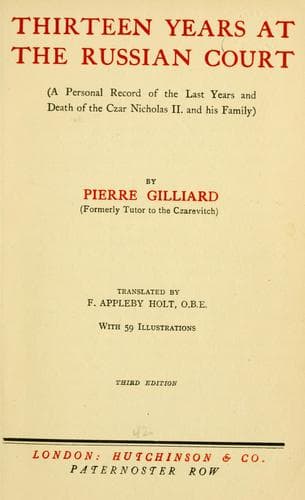
Thirteen years at the Russian court: (a personal record of the last years and death of the Czar Nicholas II. and his family) — John Shaqi
Thirteen years at the Russian court: (a personal record of the last years and death of the Czar Nicholas II. and his family)Gilliard, Pierre
History
Thirteen years at the Russian court: (a personal record of the last years and death of the Czar Nicholas II. and his family)
Gilliard, Pierre
Nicholas II, Emperor of Russia, 1868-1918; Romanov, House of; Soviet Union -- History -- Revolution, 1917-1921 -- Personal narratives
I remember one occasion when a deputation of peasants from one of the
Governments of Central Russia came to bring presents to the Czarevitch.
The three men of which it was composed, on an order given by Derevenko
in a low voice, dropped on their knees before Alexis Nicolaïevitch to
offer him what they had brought. I noticed that the boy was embarrassed
and blushed violently, and when we were alone I asked him whether he
liked seeing people on their knees before him.
“Oh no, but Derevenko says it _must_ be so!”
“That’s absurd!” I replied. “Even the Czar doesn’t like people to kneel
before him. Why don’t you stop Derevenko insisting on it?”
“I don’t know. I dare not.”
I took the matter up with Derevenko, and the boy was delighted to be
freed from this irksome formality.
But a more serious element was his isolation and the circumstances under
which his education was carried on. I realised that these were almost
inevitable, and that the education of a prince tends to make him an
incomplete being who finds himself outside life if only because he has
not been subject to the common lot in his youth. Such teaching as he
receives can only be artificial, tendencious, and dogmatic. It often has
the absolute and uncompromising character of a catechism.
There are several reasons: the restricted choice of teachers, the fact
that their liberty of expression is limited by the conventions of their
official life and their regard for the exalted position of their pupil,
and, finally, that they have to get through a vast programme in a very
few years. It inevitably means that they have to resort to mere formulæ.
They proceed by assertion, and think less of rousing the spirit of
enquiry and analysis and stimulating the faculty of comparison in their
pupils than of avoiding everything which might awaken an untimely
curiosity and a taste for unofficial lines of study.
Further, a child brought up in such conditions is deprived of something
which plays a vital part in the formation of judgment. He is deprived of
the knowledge which is acquired out of the schoolroom, knowledge such as
comes from life itself, unhampered contact with other children, the
diverse and sometimes conflicting influences of environment, direct
observation and simple experience of men and affairs--in a word,
everything which in the course of years develops the critical faculty
and a sense of reality.
Under such circumstances an individual must be endowed with exceptional
gifts to be able to see things as they are, think clearly, and desire
the right things.
He is cut off from life. He cannot imagine what is going on behind the
wall on which false pictures are painted for his amusement or
distraction.
Public-domain text, read in full here on John Shaqi.
Reviews
Reviews
No reviews yet
Be the first to share your thoughts on this work.
Join the Discussion
Join the discussion
Sign in to leave a comment or review.
Sign InorCreate an account