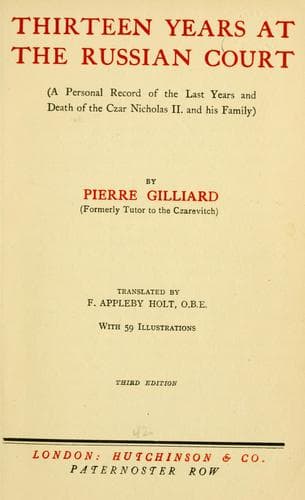
Thirteen years at the Russian court: (a personal record of the last years and death of the Czar Nicholas II. and his family)Gilliard, Pierre
History
Thirteen years at the Russian court: (a personal record of the last years and death of the Czar Nicholas II. and his family)
Gilliard, Pierre
Nicholas II, Emperor of Russia, 1868-1918; Romanov, House of; Soviet Union -- History -- Revolution, 1917-1921 -- Personal narratives
It was with no eye to personal advantage, but out of a pure affection
for the Imperial family and her desire to help them, that Madame
Wyroubova tried to keep the Czarina posted as to what was going on, to
make her share her likes and dislikes, and through her to influence the
course of affairs at Court. But in reality she was the docile and
unconscious, but none the less mischievous, tool of a group of
unscrupulous individuals who used her in their intrigues. She was
incapable either of a political policy or considered aims, and could not
even guess what was the game of those who used her in their own
interests. Without any strength of will, she was absolutely under the
influence of Rasputin and had become his most fervent adherent at
Court.[17]
I had not seen the _staretz_ since I had been at the palace, when one
day I met him in the anteroom as I was preparing to go out. I had time
to look well at him as he was taking off his cloak. He was very tall,
his face was emaciated, and he had piercing grey-blue eyes under thick
bushy eyebrows. His hair was long, and he had a long beard like a
peasant. He was wearing a Russian smock of blue silk drawn in at the
waist, baggy black trousers, and high boots.
This was our one and only meeting, but it left me with a very
uncomfortable feeling. During the few moments in which our looks met I
had a distinct impression that I was in the presence of a sinister and
evil being.
* * * * *
The months slipped by, however, and I had the pleasure of observing the
progress made by my pupil. He had grown fond of me and was trying to
respond to the trust I showed in him. I still had a hard struggle
against his laziness, but the feeling that the amount of liberty
permitted him depended entirely upon the use he made of it fired his
zeal and strengthened his will.
It was fortunate that the winter had been a good one, and there had been
no other serious relapse after that at Livadia.
Of course I knew quite well that this was only an interlude, but I
noticed that Alexis Nicolaïevitch was making a real effort to control
his impulsive and turbulent nature, which had unfortunately caused
serious accidents, and I began to wonder whether I should not find his
illness, however terrible in other ways, an ally which would gradually
compel the boy to become his own master and might refine his character.
It was all a great comfort to me, but I cherished no illusions as to the
difficulties of my task. I had never realised so well before how his
environment fought against my efforts. I had to struggle against the
servile flattery of the servants and the silly adulations of some of the
people around him. It always surprised me greatly that Alexis
Nicolaïevitch’s simple nature had hitherto to a large extent resisted
the attraction of the extravagant praise he received.
Public-domain text, read in full here on John Shaqi.
Reviews
Reviews
No reviews yet
Be the first to share your thoughts on this work.
Join the Discussion
Join the discussion
Sign in to leave a comment or review.
Sign InorCreate an account