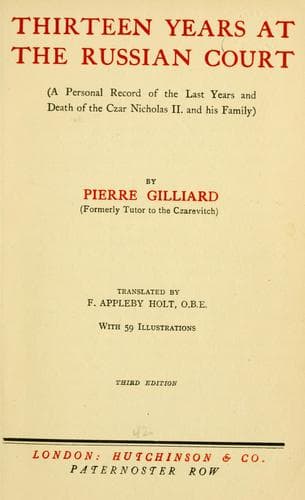
Thirteen years at the Russian court: (a personal record of the last years and death of the Czar Nicholas II. and his family)Gilliard, Pierre
History
Thirteen years at the Russian court: (a personal record of the last years and death of the Czar Nicholas II. and his family)
Gilliard, Pierre
Nicholas II, Emperor of Russia, 1868-1918; Romanov, House of; Soviet Union -- History -- Revolution, 1917-1921 -- Personal narratives
But it was the Czarina who was the special object of attack. The worst
insinuations about her conduct had gained currency and were believed
even by circles which hitherto had rejected them with scorn. As I have
said, the presence of Rasputin at Court was a growing blot on the
prestige of the sovereigns, and gave rise to the most malicious
comments. It was not as if the critics confined themselves to attacks
upon the private life of the Czarina. She was openly accused of
Germanophile sympathies, and it was suggested that her feelings for
Germany could become a danger to the country. The word “treason” was not
yet heard, but guarded hints showed that the suspicion had been planted
in a good many heads. I knew that all this was the result of German
propaganda and intrigues.[42]
I have explained above that in the autumn of 1915 the Berlin Government
had realised that they could never overthrow Russia as long as she stood
united round her Czar, and that from that moment her one idea had been
to provoke a revolution which would involve the fall of Nicholas II. In
view of the difficulties of attacking the Czar directly, the Germans had
concentrated their efforts against the Czarina and begun a subterranean
campaign of defamation against her. It was skilfully planned and began
to show results before long. They had stopped at nothing in the way of
calumny. They had adopted the classic procedure, so well known to
history, of striking the monarch in the person of his consort. It is, of
course, always easier to damage the reputation of a woman, especially
when she is a foreigner. Realising all the advantages to be derived from
the fact that the Czarina was a German princess, they had endeavoured to
suggest very cunningly that she was a traitor to Russia. It was the best
method of compromising her in the eyes of the nation. The accusation had
been favourably received in certain quarters in Russia and had become a
formidable weapon against the dynasty.
The Czarina knew all about the campaign in progress against her and it
pained her as a most profound injustice, for she had accepted her new
country, as she had adopted her new faith, with all the fervour of her
nature. She was Russian by sentiment as she was orthodox by
conviction.[43]
My residence behind the front also enabled me to realise how much the
country was suffering from the war. The weariness and privations were
causing general discontent. As a result of the increasing shortage of
rolling-stock, fuel, which had been cruelly scarce in the winter,
continued to be unpurchasable. It was the same with food, and the cost
of living continued to rise at an alarming rate.
* * * * *
Public-domain text, read in full here on John Shaqi.
Reviews
Reviews
No reviews yet
Be the first to share your thoughts on this work.
Elsewhere in the archive
Join the Discussion
Join the discussion
Sign in to leave a comment or review.
Sign InorCreate an account