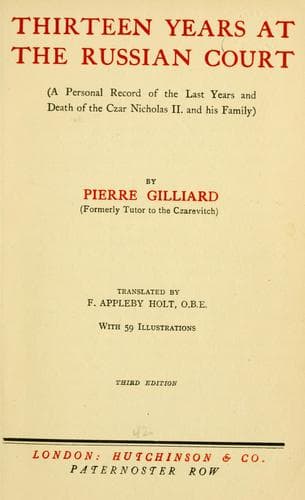
Thirteen years at the Russian court: (a personal record of the last years and death of the Czar Nicholas II. and his family)Gilliard, Pierre
History
Thirteen years at the Russian court: (a personal record of the last years and death of the Czar Nicholas II. and his family)
Gilliard, Pierre
Nicholas II, Emperor of Russia, 1868-1918; Romanov, House of; Soviet Union -- History -- Revolution, 1917-1921 -- Personal narratives
On August 11th I returned to G.H.Q. thoroughly perturbed at all I had
seen and heard. It was pleasant to find the atmosphere at Mohileff very
different from that at Petrograd, and to feel the stimulating influence
of circles which offered so stern a resistance to the “defeatist” spirit
at work at home. Yet the authorities there were very concerned at the
political situation, although that was not so obvious at first sight.
Alexis Nicolaïevitch gave me a very affectionate welcome when I came
back (he had written to me regularly while I was away), and the Czar
received me with exceptional kindness. I could thus congratulate myself
on the result of leaving my pupil for some time, especially as it might
have been a false step, and I took up my duties again with renewed
energies. My English colleague, Mr. Gibbes, had meanwhile joined us, and
as M. Petroff remained with us, the Czarevitch’s lessons could proceed
practically regularly.
At the front the fighting had gradually died down in the northern and
central sectors. It continued only in Galicia, where the Russians were
still driving the Austrians before them, and their defeat would long
since have become a flight if they had not been supported by a large
number of German regiments.
The campaign of 1916, however, had convinced the Russian General Staff
that they would never break the resistance of the enemy and secure final
victory so long as they suffered from so great a lack of artillery.
Their inferiority in that respect prevented a thorough exploitation of
the successes gained by the courage of the troops and their numerical
superiority at the beginning of each attack. There was nothing for it
but to wait until the material promised by the Allies, the delivery of
which had been delayed by difficulties of transport, was ready and
available.
The Austrian defeats had had a very great effect on Rumania. She was
more and more inclined to associate herself with the cause of the
Entente, but she was still hesitating to enter the arena. The Russian
Minister at Bucharest had had to bring strong pressure to bear to induce
her to make up her mind.[44]
On August 27th Rumania at length declared war. Her position was very
difficult, as she was on the extreme left flank of the immense Russian
front, from which she was separated by the Carpathians. She was
threatened with an Austro-German attack from the north and west, and
could be taken in rear by the Bulgarians. That is exactly what happened,
and the beginning of October marked the beginning of the reverses which
were to end only with the occupation of almost the whole of Rumania.
Public-domain text, read in full here on John Shaqi.
Reviews
Reviews
No reviews yet
Be the first to share your thoughts on this work.
Elsewhere in the archive
Join the Discussion
Join the discussion
Sign in to leave a comment or review.
Sign InorCreate an account