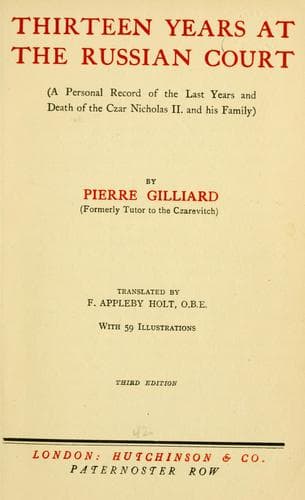
Thirteen years at the Russian court: (a personal record of the last years and death of the Czar Nicholas II. and his family)Gilliard, Pierre
History
Thirteen years at the Russian court: (a personal record of the last years and death of the Czar Nicholas II. and his family)
Gilliard, Pierre
Nicholas II, Emperor of Russia, 1868-1918; Romanov, House of; Soviet Union -- History -- Revolution, 1917-1921 -- Personal narratives
As soon as the danger was apparent the Russian General Staff had taken
steps to send help to the Rumanian army, but the distances were great
and the communications extremely defective. Nor was Russia in a position
to reduce the effectives on her own front to any serious degree, for in
case of urgent necessity she would have found herself unable to retrieve
the divisions sent to Rumania in time. Under pressure from the Czar,
however, all the available reinforcements had been directed there. The
question was whether these troops would arrive in time to save
Bucharest.
We returned to Tsarskoïe-Selo on November 1st. The impression made by
the Rumanian disaster had been great, and the Minister for Foreign
Affairs had been held responsible. At the beginning of the year Sturmer
had succeeded Goremykin as President of the Council of Ministers. His
appointment had been badly received, and he had simply made one fault
after another. It had been as the result of his intrigues that Sazonoff,
who had rendered such great services as Foreign Minister, had had to
resign, and Sturmer had hastened to take his place while remaining
President of the Council.
He was hated as much for his name as his acts. It was alleged that he
only kept himself in power thanks to the influence of Rasputin. Some
even went so far as to accuse him of pro-German sympathies, and to
suspect him of favouring a separate peace with Germany.[45] Nicholas II.
compromised himself by keeping for so long a Minister whom all
suspected. It was hoped that the Czar would ultimately realise that he
had been deceived once more, but we all feared that he would find out
only too late, when the harm done was irremediable.[46]
CHAPTER XIV
POLITICAL TENSION--THE DEATH OF RASPUTIN
(DECEMBER, 1916)
The political atmosphere became more and more heavy, and we could feel
the approach of the storm. Discontent had become so general that in
spite of the censorship the Press began to speak about it. Party feeling
ran ever higher, and there was only one point on which opinion was
unanimous--the necessity of putting an end to the omnipotence of
Rasputin. Everyone regarded him as the evil counsellor of the Court and
held him responsible for all the disasters from which the country was
suffering. He was accused of every form of vice and debauchery and
denounced as a vile and loathsome creature of fantastic habits, and
capable of baseness and ignominy of every kind. To many he was an
emanation of the devil himself, the anti-Christ whose dreaded coming was
to be the signal for the worst calamities.
Public-domain text, read in full here on John Shaqi.
Reviews
Reviews
No reviews yet
Be the first to share your thoughts on this work.
Elsewhere in the archive
Join the Discussion
Join the discussion
Sign in to leave a comment or review.
Sign InorCreate an account