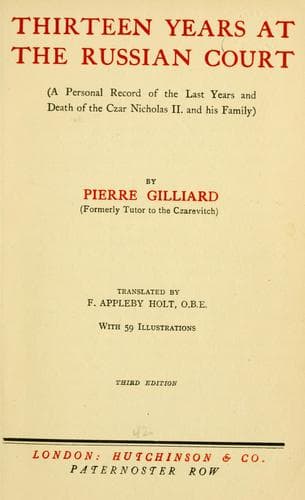
Thirteen years at the Russian court: (a personal record of the last years and death of the Czar Nicholas II. and his family)Gilliard, Pierre
History
Thirteen years at the Russian court: (a personal record of the last years and death of the Czar Nicholas II. and his family)
Gilliard, Pierre
Nicholas II, Emperor of Russia, 1868-1918; Romanov, House of; Soviet Union -- History -- Revolution, 1917-1921 -- Personal narratives
The Czar had resisted the influence of Rasputin for a long time. At the
beginning he had tolerated him because he dare not weaken the Czarina’s
faith in him--a faith which kept her alive. He did not like to send him
away, for if Alexis Nicolaïevitch had died, in the eyes of the mother he
would have been the murderer of his own son. Yet he had maintained a
cautious reserve, and had only gradually been won over to the views of
his wife. Many attempts had been made to enlighten him as to the true
character of Rasputin and secure his dismissal. His confidence had been
shaken, but the Czar had never yet been convinced.[47]
On November 6th we left Tsarskoïe-Selo, and after a short stay at
Mohileff we left on the 9th for Kieff, where the Czar was to visit the
Dowager Empress. He stayed two days in the company of his mother and
some of his relations, who did their best to show him how serious the
situation was and persuade him to remedy it by energetic measures. The
Czar was greatly influenced by the advice which was given him. He had
never seemed to me so worried before. He was usually very
self-controlled, but on this occasion he showed himself nervous and
irritable, and once or twice he spoke roughly to Alexis Nicolaïevitch.
We returned to G.H.Q. on the 12th, and a few days later Sturmer fell, to
the unconcealed relief of everyone. The Czar entrusted the office of
President of the Council to A. Trepoff, who was known as an advocate of
moderate and sane reforms. Hope revived. Unfortunately the intrigues
continued. The Germans flattered themselves that these were only the
prelude to grave troubles and redoubled their efforts, sowing the seeds
of doubt and suspicion everywhere and trying to compromise the Court
beyond repair in the eyes of the nation.
Trepoff had asked the Czar to dismiss the Minister of the Interior,
Protopopoff, whose utter inefficiency and the fact that he was a
disciple of Rasputin had made him bitterly unpopular. The President of
the Council felt that he would never be able to do anything useful so
long as that Minister remained at his post, for all the politicians of
any standing proclaimed their helplessness and were refusing to accept
responsibility.
The courageous initiative of patriots such as Sazonoff, Krivoshin,
Samarin, Ignatieff, and A. Trepoff--to mention but a few--was not
supported as it might have been. If the intelligent masses of the nation
had grouped themselves round them the growing peril could have been
averted and in quite legal fashion. But these men did not receive the
support they were entitled to expect. Criticism and the intrigues and
rivalries of individuals and parties prevented that unity which alone
could have saved the situation.
Public-domain text, read in full here on John Shaqi.
Reviews
Reviews
No reviews yet
Be the first to share your thoughts on this work.
Elsewhere in the archive
Join the Discussion
Join the discussion
Sign in to leave a comment or review.
Sign InorCreate an account