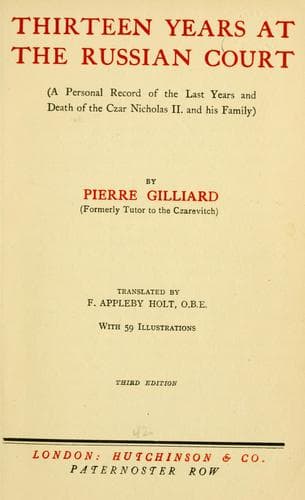
Thirteen years at the Russian court: (a personal record of the last years and death of the Czar Nicholas II. and his family)Gilliard, Pierre
History
Thirteen years at the Russian court: (a personal record of the last years and death of the Czar Nicholas II. and his family)
Gilliard, Pierre
Nicholas II, Emperor of Russia, 1868-1918; Romanov, House of; Soviet Union -- History -- Revolution, 1917-1921 -- Personal narratives
If unity had been realised it would have represented a power such as
would have paralysed the evil influence of Rasputin and his adherents.
Unfortunately those who did realise it were the exception. The majority
kept out of a disagreeable conflict, and by retiring from the field left
it free to adventurers and the apostles of intrigue. They made no effort
to lighten the burden of the men who realised the danger and had
undertaken to save the Czar, in spite of himself, and to support the
tottering régime until the end of the war.
The Czar had originally acquiesced in Trepoff’s suggestion, but under
the influence of the Czarina he had changed his mind and remained
irresolute, not knowing what to decide. He had been deceived so often
that he did not know in whom he could have confidence. He felt himself
alone and deserted by all. He had spent himself without reflection since
he had assumed the Supreme Command, but the burden he had taken upon his
shoulders was too heavy and beyond his strength. He realised the fact
himself. Hence his weakness towards the Czarina, and the fact that he
tended more and more to yield to her will.
Yet many of the decisions he had taken in 1915 and his visit to the Duma
in February, 1916, show that till then, at any rate, he could resist her
when he was sure that it was for the good of the country. It was only in
the autumn of 1916 that he succumbed to her influence, and then only
because he was worn out by the strain of his double functions as Czar
and Commander-in-Chief, and in his increasing isolation he did not know
what to do to escape a situation which was getting worse from day to
day. If he had received better support at that time from the moderate
parties, who can say that he would not have found the strength to
continue his resistance!
The Czarina herself sincerely believed--on the strength of Rasputin’s
word--that Protopopoff was the man who could save Russia. He was kept in
office, and Trepoff, realising his impotence, lost no time in resigning
his post.
* * * * *
We returned to Tsarskoïe-Selo on December 8th. The situation was
becoming more strained every day. Rasputin knew that the storm of hatred
was gathering against him, and dare not leave the little flat he
occupied in Petrograd. Exasperation with him had reached fever-heat, and
the country was waiting for deliverance and fervently hoping that
someone would remove the man who was considered the evil genius of
Russia. But Rasputin was well guarded. He had the protection of the
Imperial police, who watched over his house night and day. He had also
the protection of the Revolutionary Socialists, who realised that he was
working for them.
Public-domain text, read in full here on John Shaqi.
Reviews
Reviews
No reviews yet
Be the first to share your thoughts on this work.
Elsewhere in the archive
Join the Discussion
Join the discussion
Sign in to leave a comment or review.
Sign InorCreate an account